top of page

柏林(Berlin)|东柏林

  • 作家相片: Maximus Nostramabus
    Maximus Nostramabus
  • 2天前
  • 讀畢需時 17 分鐘

已更新:1小时前

那堵将人们与爱、自由和尊严隔绝开来的墙 - 柏林的博物馆岛 896;欧洲大教堂作坊或包胡腾的工艺技术和习惯做法、专有技术、传播、知识的发展和创新 01558

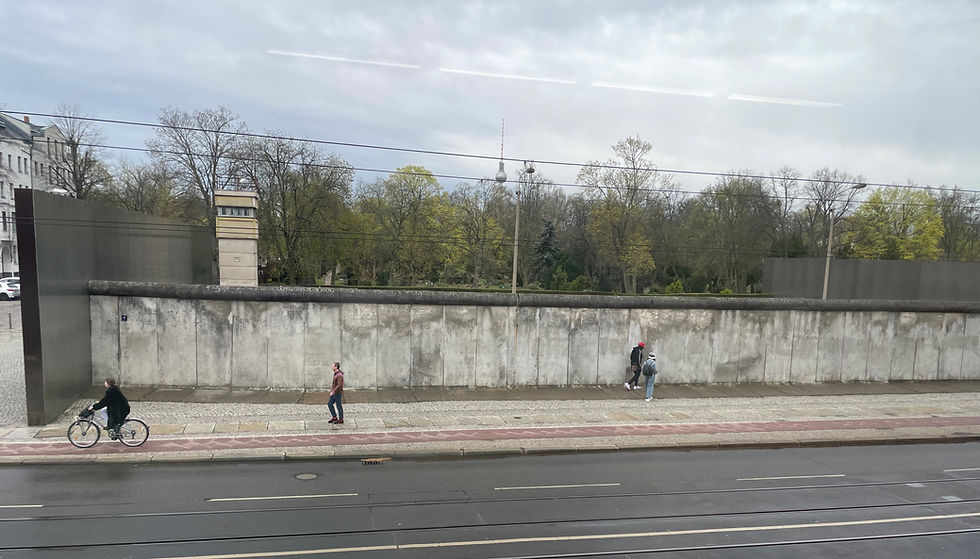
贝尔瑙尔大街上的柏林墙遗址及其重建的瞭望塔

这可能是我写的第一篇并非以世遗为主题的博客。事实上,这道城墙的历史意义远远超过这座充满活力的城市中的任何旅游景点。

什么和为什么

柏林围墙(德语:Berlin Mauer)是二十世纪最具影响力的物质和象征性建筑之一。它建于1961年,于1989年被戏剧性地拆除,将柏林(Berlin)一分为二,象征着冷战(英语:Cold War时期意识形态、政治和军事上的对抗、两极分化和分裂。柏林墙作为“铁幕(英语:Iron Curtain”的又一象征,也让我想起世界曾经一度濒临第三次世界大战的边缘。而近期的地缘政治事件,似乎又让我们意识到这种不太可能发生的局面正在重现。

柏林围墙不仅仅是一道混凝土和铁丝网构成的屏障,它更代表着一套控制、隔离和监视体系。它展现了西方民主和资本主义与东方集团(英语:Eastern Bloc共产主义和控制之间的斗争。时至今日,它依然是压迫的象征,同时也寄托着和平变革的可能性和希望。我至今仍清晰地记得青少年时期在电视上观看柏林墙倒塌的全过程:那些戏剧性的事件,以及人们冲破柏林墙后喜极而泣的场景。

在意识形态光谱的另一端,位于东柏林(Ost-Berlin)中心的博物馆岛(Museumsinsel)矗立着。十九世纪初,在启蒙思想(英语:Enlightenment自由主义(英语:liberalism的影响下,欧洲统治者开始将艺术和古董视为公共教育的资源,而非私人炫耀的资本。在普鲁士(Preußen),这一转变得到了国王腓特烈威廉三世(本名 Friedrich Wilhelm von Hohenzollern的大力支持,他批准了将皇家收藏向公众开放的计划。这标志着从王室珍奇柜到现代博物馆的转变。施普雷岛(Spreeinsel当时属于普鲁士领土)上的第一座博物馆建筑是老博物馆(Altes Museum),于1830年开放。随着藏品的不断丰富,需要建造更多的博物馆,于是岛上陆续兴建了更多博物馆,最终形成了今天的博物馆岛。与柏林墙截然相反,博物馆岛代表着一种截然不同的理念:它旨在创建一个自由的艺术与科学教育圣地,在这里,文物和藏品不再作为权威或奢侈品的象征,而是作为一种共享文化和教育理念的民主叙事而展出。

地名

虽然大多数词源学研究尚未得出确切结论,但目前最被广泛接受的理论认为,柏林这个名字源于斯拉夫语词根“berl”,意为“沼泽”或“湿地”。该词的后缀“-in”强化了其发音,而这个后缀在现代斯拉夫语中仍然很常见。

一种民间词源学(英语:folk etymology观点认为,柏林这个城市名称源于德语单词“Bär”,意为“熊”,而熊也是柏林的象征。尽管这种说法广为流传,但在科学和词源学上都被认为是错误的。

柏林围墙(Berlin Mauer)

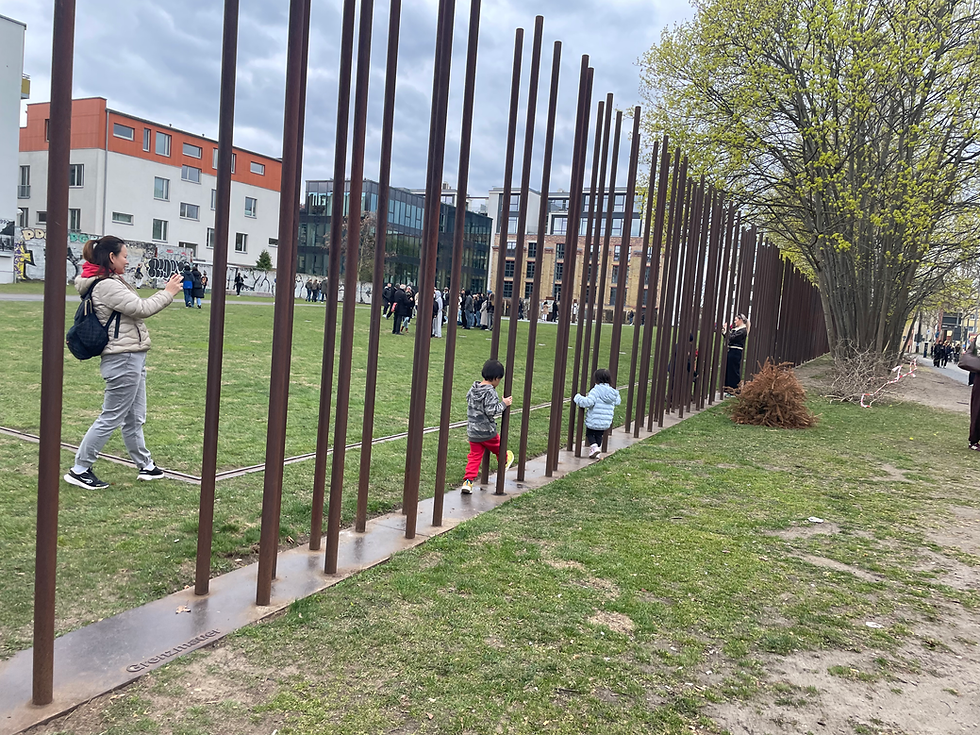
孩子们在外墙上穿梭,内墙在背景中
孩子们在外墙上穿梭,内墙在背景中

二战结束后,柏林立即被完全瓜分,落入盟军(英语:Allies之手。这一决定于1945年7月在波茨坦会议(Potsdamer Konferenz)上正式做出,而此时距离纳粹德国(Deutsches Reich)无条件投降仅两个月。事实上,早在当年雅尔塔会议(俄语:Ялтинская конференция)上,当纳粹(Nazi)战败已成定局时,柏林的瓜分就已经确定。当时,德国(Deutschland被划分为四个占领区,但令人匪夷所思的是,首都柏林却完全被苏联(俄语:Советский Союз)控制的东德(Deutsche Demokratische Republik)所包围,如下图所示。因此柏林内部存在着三个“自由世界”:西侧是美国、英国和法国的占领区,完全被共产主义东德和苏联控制的东柏林所包围。

分裂的柏林及其柏林围墙(网图)
分裂的柏林及其柏林围墙(网图)

显然,东西柏林的生活截然不同,这源于两地截然不同的意识形态和政治体制。自柏林分裂以来,许多东德人试图逃往西柏林,寻求他们所渴望的一切。然而,也有少数西德人为了与家人团聚或其他原因叛逃到东德。起初边界管制相对宽松。事实上,许多房屋就位于边界两侧,因为边界的划定确实带有随意性。居民们像我上面提到的孩子们一样,可以自由穿梭于边界之间,有时甚至在自己家中,只有一些松散的检查和控制。东西柏林之间的物质交流仍在继续。

然而,随着时间的推移,越来越多的人逃离东德,管制也日益严格。这些叛逃事件也令东欧集团感到尴尬,因为东德实际上是苏联的附庸国(英语:vassal state,必须加以制止。最终,在1961年,为了阻止这些逃亡和叛逃,当局决定分阶段修建长达一百五十五公里的柏林围墙。一夜之间,许多家庭被彻底隔离,柏林的两部分几乎完全隔绝。

贝尔瑙尔大街的围墙位置
贝尔瑙尔大街的围墙位置

尽管西柏林得到了西方相当充足的物资供应和支持,以“炫耀”西方的实力,但即便享有所谓的自由,西柏林的生活也远非真正意义上的美好。这座城市完全被东德包围,进出城的检查和管制可想而知。所有陆路物资都必须经过数量有限的检查站,而所有通过这些检查站的物品自然都会受到严格审查,这常常导致严重的延误。此外,西柏林人的国籍也十分模糊:虽然从技术上讲,他们是美国人、英国人或法国人(因为这些地区实际上是各自的殖民地),但他们持有西德(Bundesrepublik Deutschland)护照,却并未真正被视为西德公民。

即使有柏林围墙的存在,仍然有无数人通过攀爬和挖掘隧道逃离,寻求自由、与家人团聚或仅仅是为了改善经济状况。虽然许多人成功逃脱,并在街头留下了标记(如下图所示),但大多数人失败了,被捕或被杀。最令人震惊的逃脱事件是一位东德士兵的所为,他被拍到跳过柏林围墙的铁丝网,如下方贝尔瑙尔大街(Bernauer Straße)的壁画所示,这条街现在保留着柏林围墙的一些最佳遗迹和纪念碑。

翻译:三人逃脱
翻译:三人逃脱

在我们参观的博物馆里,看完视频后,我意识到大多数逃亡者并不像西方媒体经常描绘的那样在意自由:他们只是想要更好的生活,很可能是经济上的改善;有人提到,他们只是想体验西方更明亮的灯光或更时尚的服饰,一些更基本、更根本的东西;还有人说,他们只是厌倦了灌输思想。正如前文所述,在西柏林地区,人们并没有真正感受到自由的优势,因此自由并没有被视为一项重要的议题。
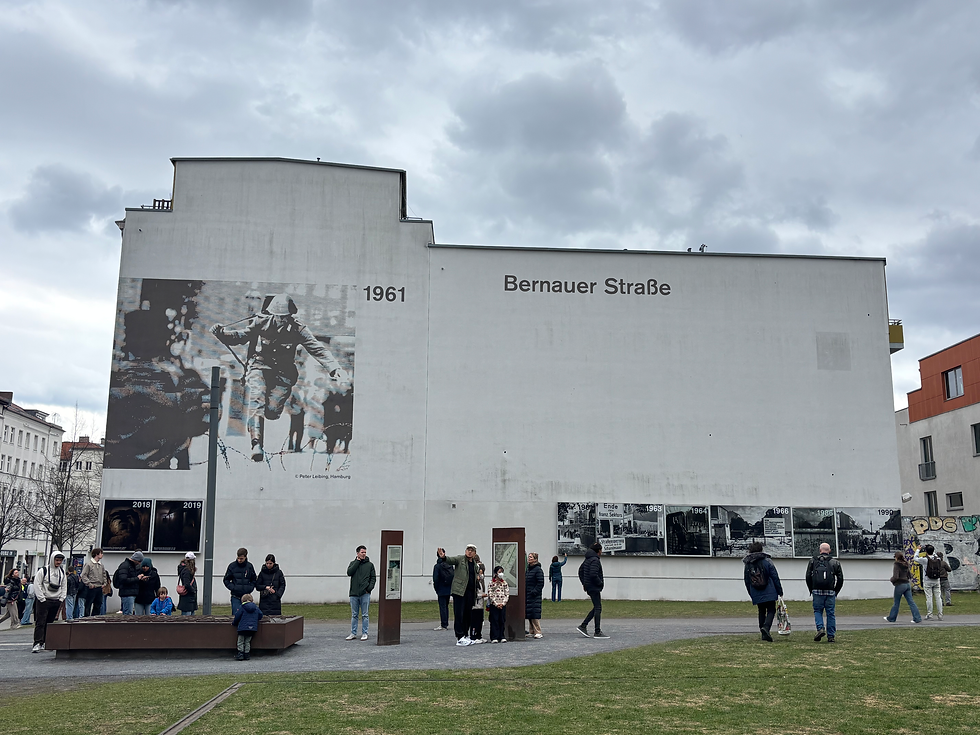
贝尔瑙尔大街的壁画和纪念墙
贝尔瑙尔大街的壁画和纪念墙

柏林围墙的建立很快被人们接受:墙两侧的居民迅速适应了新的生活,并接受了现实。贝尔瑙大街沿线的几栋建筑里,人们经常互相挥手致意。柏林的火车在边界处就停靠,比如贝尔瑙大街火车站(Bernauer Straße)。而墙另一侧的建筑要么被拆除以修建柏林围墙,要么本身就成了柏林围墙的一部分。

柏林围墙遗迹
柏林围墙遗迹

由于东欧集团经济问题日益严重,以及苏联在时任苏联领导人米哈伊尔戈尔巴乔夫(俄语:Михаил Горбачёв)领导下的民主化时期(俄语:демократизация,其干预立场有所软化,东欧集团在二十世纪八十年代末开始逐渐失去控制并走向解体。1989年6月,匈牙利(匈牙利语:Magyarország)在媒体面前单方面开放了与奥地利(Österreich)的边界,柏林围墙的倒塌已成定局。1989年11月9日,德国政府宣布立即开放柏林围墙边界。起初,东德士兵仍然坚守着边界,但到了晚上10点45分,其中一个边境检查站终于让步,所有检查站的闸门也随之打开,东西柏林人在经历了二十八年的隔离后终于重聚。柏林围墙开始倒塌,大量民众纷纷跳上柏林围墙的各个部分,开始拆除。这一切都是我在电视直播中亲眼目睹的,至今记忆犹新。当时人们庆祝这场胜利,视之为民主和自由的胜利;但我从未想过,有一天我和我的孩子们会站在这里,买一块柏林围墙的碎片作为纪念品。

柏林围墙典型结构(网图)
柏林围墙典型结构(网图)

回到柏林墙的结构,虽然由于地理位置、地形和交通状况的不同,柏林墙在其一百五十五公里长的路线上建筑结构有所差异,但大部分都像监狱一样建造。它至少有三层:靠近东柏林的内层设有围栏和铁丝网;中间层是防车沟,用于阻止车辆通行或碰撞;外层顶部采用专利圆柱形设计,以阻止攀爬。中间层的地面全部是沙砾,用来标记脚印并阻碍人员和车辆的通行。中间层设有瞭望塔、狗道、铁丝网、电网、钉床以及各种各样的陷阱,应有尽有。如果有人试图逃跑,实际上就等于默认落入了死亡陷阱。尽管如此,许多人仍然设法幸存下来并成功逃脱。下图展示了一座重建的瞭望塔,它包含了完整的三层结构。

重建的柏林围墙的三层结构
重建的柏林围墙的三层结构

如今柏林围墙几乎完全损毁,只剩下零星残迹。在我们参观过的众多纪念馆和柏林围墙遗址中,位于贝尔瑙大街的柏林围墙纪念馆(Gedenkstätte Berliner Mauer)无疑是策划和组织得最好的。馆内设有大量视频和展品,以客观、简洁而生动的叙述方式展现了柏林围墙及其相关历史。事实上,我沿着贝尔瑙大街走向柏林围墙公园(Mauerpark)的途中,沿途有很多景点都展示了当年的逃生通道、隧道以及柏林围墙的各个小段,并配有精美的展品。与下方的查理检查站(英语:Checkpoint Charlie相比,纪念馆及其周边环境更显原始,游客较少,甚至有些阴郁(或许是因为我参观时的天气原因)。柏林之行,不容错过。

柏林围墙纪念馆
柏林围墙纪念馆

查理检查站(Checkpoint Charlie)

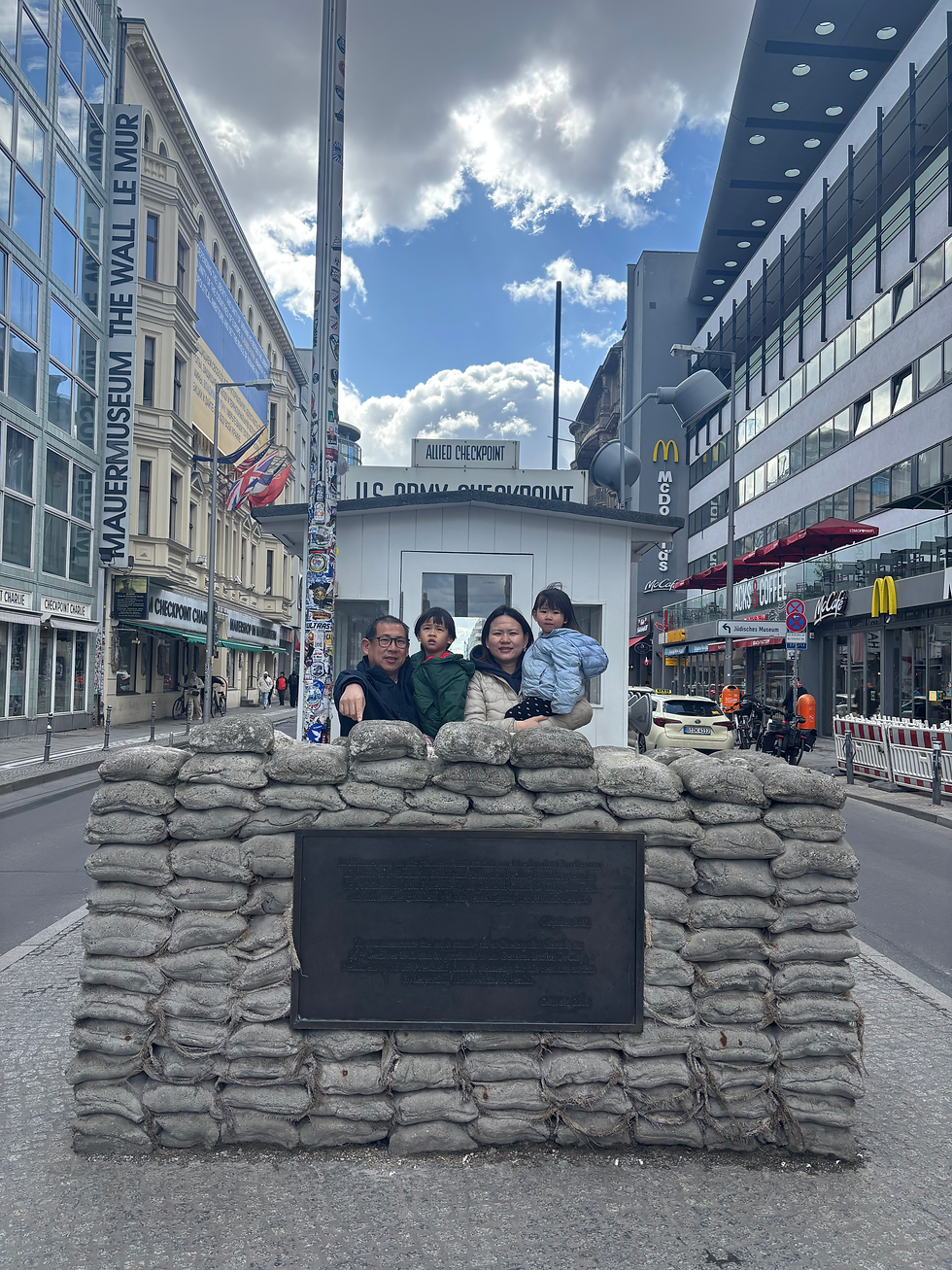
我家在查理检查站
我家在查理检查站

查理检查站是东西柏林之间三大陆路过境点之一,也是柏林围墙倒塌后唯一保留下来的。“查理”一词源于国际无线电报拼写字母表(英语:International Radiotelephony Spelling Alphabet中的字母“C”。检查站 A 和 检查站 B 都已不复存在,而查理检查站位于市中心,如今已成为一个过度喧闹的旅游景点。

我很久以前就通过电影《八爪女(英语:Octopussy》认识了查理检查站,最近又在电脑游戏《使命召唤:黑色行动(英语:Call of Duty: Black Ops》中看到了它。

它具有重要的历史意义,因为它位于美占区。由于冷战时期美苏对抗,这里曾发生过许多事件,例如1961年柏林围墙建成后不久,美苏坦克在边境对峙的场景。

查理检查站标志
查理检查站标志

上图所示的警卫室实际上是原址上的复制品,沙袋是用混凝土做的。总是有很长的队伍等着像我们一样在沙袋后面拍照。真正的警卫室现在被收藏在博物馆里。

说实话,周围的喧嚣掩盖了它的历史意义,而且附近的博物馆也远不如柏林围墙纪念馆。此外,这片区域遍布麦当劳(英语:McDonald's、旅游陷阱和高耸的商业建筑,让我想起的更多是华尔街(英语:Wall Street而不是柏林围墙:墙(英语:wall)的这两个含义截然不同。

克里姆林宫最后的旗帜
克里姆林宫最后的旗帜

由于其地理位置,这里仍然保留着许多共产主义历史的遗迹,例如最后一面克里姆林宫(俄语:Кремль)旗帜以及其他来自东德政权的旗帜。

Museum Island (Museumsinsel)

While clearly Berlin Wall is always the main focal attraction, what really drew me to come to Berlin is the WHS of Museum Island. As mentioned above, the origins of Museum Island lie in the transformation of royal collections into public institutions under the influence of Enlightenment ideals under Prussian rules. This shift was strongly supported by Friedrich Wilhelm III, who approved plans to make the royal collections accessible to the public.

Located in the heart of Berlin, the Museum Island in East Berlin is a stunning ensemble of seven world-renowned museums, built between mid-19th to 20th century. Not only are these museums' curation and collections world-class, these museums are also famous for its grand neoclassical architecture. When I got out of the metro and arrived at the island, honestly it looked like I went to Athens (Αθήνα)! Even without entering into the museums is already a joy to the eyes to me!

Museum Island plan
Museum Island plan

Technically the museums occupy only the northern part of the Spree Island and the following museums are included as WHS: Altes Museum, Neues Museum, Alte Nationalgalerie, Pergamonmuseum, James Simon Gallery (James-Simon-Galerie) and Bode Museum. The island also includes a number of famous, important and beautiful buildings like the Berlin Cathedral (Berliner Dom), Humboldt Forum, Lustgarten, German Chambers of Industry and Commerce (Deutsche Industrie- und Handelskammer) and Berlin Central and Regional Library (Zentral- und Landesbibliothek Berlin), though these landmarks do not form part of WHS.

During the Cold War, Museum Island in East Berlin was left in ruins after World War II, with heavily damaged buildings like the Neues Museum abandoned for decades. Some of the museums became propaganda sites of East Germany: the Altes Museum became a parade backdrop. Many artefacts were looted by the Soviet Army and divided and split between East and West Berlin, only partially reunited after German reunification.  Following the division of the city, restoration efforts to reintegrate the collections did not begin until after 1990s, leading to its eventual WHS status in 1999.

We tried to visit all of them cursorily during our trip:

  • Altes Museum

Our family in front of Altes Museum

The museum that started it all, the museum focusses on classical antiquities (Antikensammlung) with an emphasis on Greek artefacts. Originally named the Royal Museum (Königliches Museum), it was named the Altes Museum, when the Neues Museum was built. We spent the most time here.

  • Alte Nationalgalerie

Alte Nationalgalerie

The Alte Nationalgalerie is home to paintings and sculptures of the 19th century, especiallly for its collection of Romanticism, Impressionism and early Modernism. The building itself is an integration of between late Classicism and early Neo-Renaissance, and to me it looks like a mix between a Greek temple, a church and a theatre. Amongst the many we recognised one of the casts of The Thinker (French: Le Penseur) by Auguste Rodin.

The Thinker in Alte Nationalgalerie
  • Neues Museum

Next door the Altes Nationalgalerie stands the large Neues Museum, which is famous for its pre-historic and early history artefacts, including an excellent collection of Egyptian artefacts.

Inside Neues Museum
Inside Neues Museum

The museum was badly damaged during the Second World War and the museum was left to ruins until late 1980s.

The most famous artefact of the museum is the bust of Nefertiti (Egyptian: Nfr.t jy.tj). Recall we did come across Nefertiti in our blog on Luxor (الأقصر) | West bank.

Bust of Nefertiti (from internet)

Unfortunately we did not have time to visit this museum more thoroughly.

  • James Simon Gallery

The James Simon Gallery is the newest edition to the museum collection and is reflected by its ultra-modernist facade. The building is designed to become an 'official' entrance to all the other museums in the island and thus the large staircase. The museum is named in honour of the art patron James Simon who made a huge donations to the Berlin State Museums (Staatliche Museen zu Berlin).

James Simon Gallery
James Simon Gallery
  • Pergamonmuseum

The supposed jewel in the crown Pergamonmuseum was closed during my visit. It houses artefacts from antiquity, pre-history and a world-acclaimed Middle-Eastern collection. I have to say that this was the museum that I was aiming to spend the day in, as recommended by most guidebooks. However it is closed during our visit: in fact for the next 15 years for a massive overhaul. renovation and re-curation. The entire building was wrapped under scaffoldings during our trip.

  • Bode Museum

Bode Museum
Bode Museum

To me, the most beautiful of all is the Bode Museum, which is built in a neo-Baroque style. It houses largely Byzantine arts and artefacts but we were already so exhausted that we had to give up entering.

  • Humboldt Forum

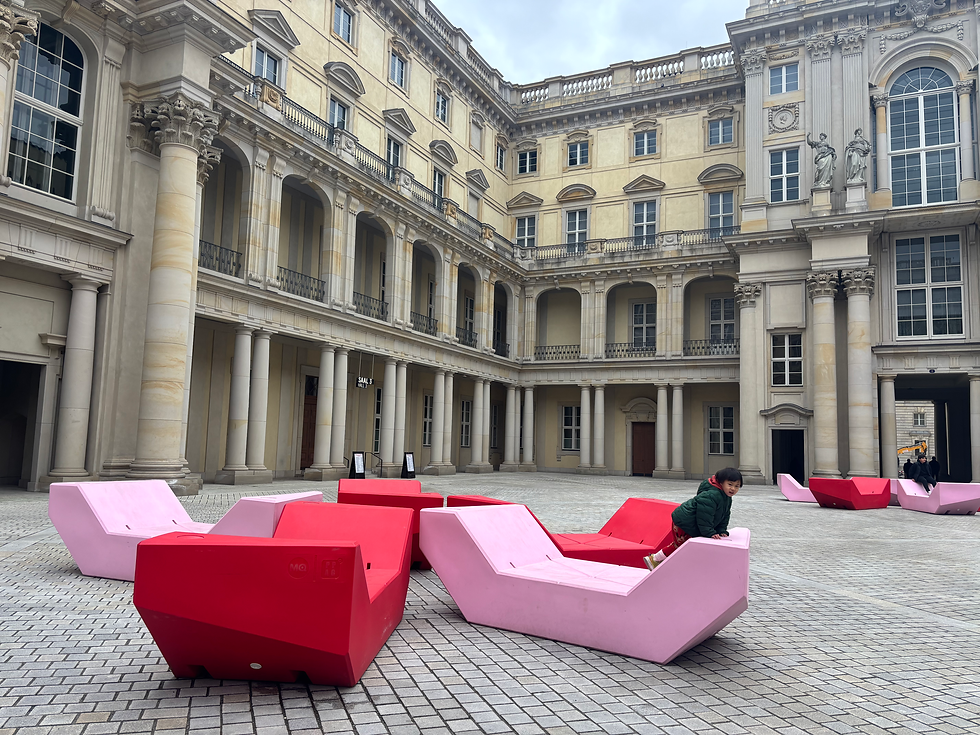
My son inside Humboldt Forum

The former Berlin Palace (Berliner Schloss) is reconstructed to become the Humboldt Forum since 2013 and is often considered the German version of the British Museum, featuring a two separate museums of Asian arts and human history and ethnography. Clearly it is named after the two prominent Prussian scholars Wilhelm and Alexander von Humboldt. We actually spent quite a bit of time here as this is actually a massive building. In fact it turns out to be one of the largest palaces of the world!

  • Berlin Cathedral (Berliner Dom)

Berlin Cathedral
Berlin Cathedral

When we arrived at Museum Island, the first landmark that we noticed was not the museums nor Humboldt Forum, it was the imosing Berlin Cathedral. A church has been on the site since the mid-15th century, but the current Baroque cathedral was actually built in the late 19th century. I tried to enter the cathedral to see what the nave looked like, only to find a long queue as the cathedral was hosting a concert during the day of visit, which it does very often. The other reason why I wanted to enter the cathedral was the fact that the crypt is the resting place for the Hohenzollern, including Friedrich Wilhelm III.

By the way, technically the Berlin cathedral is not a cathedral: it is simply a church as it has never house a bishop.

Red City Hall (Rotes Rathaus)

Red City Hall
Red City Hall

Once my day ended with Museum Island, we were sucked towards the two huge landmarks of the city, the Red City Hall (Rotes Rathaus) at Alexanderplatz. The reddish hue of the building is clearly what makes it stands out. It also took a very careful eye of me to notice the frieze on the first floor facade. The frieze tells the story and history of Berlin especially on its trade and scientific development.

Television Tower (Fernsehturm)

Television tower
Television tower

Right next to the Red City Hall stands one of the tallest buildings in Europe the Television Tower (Fernsehturm). In fact one can see the tower pretty much everywhere in the city. In spite of the modern shiny spherical facade, I have to say this is really a 'needle in my eye' as I see that it still oozes a very communist feel, and does not get really along with the surrounding locale. No wonder why the locals call it the 'toothpick (Zahnstocher)' or 'asparagus (Spargel)', whatever it is, it does not sound too nice.

Bebelplatz

Plaque commemorating the Nazi book burning

As an academic and a book lover, I must recommend visitors to come to pay a visit and tribute to Bebelplatz. The location is infamous for being one of the Nazi book burning ceremonies held on 10th May 1933. More than 20,000 books, including works from Karl Marx, Albert Einstein, Sigmund Freud and Helen Keller, considered anti-Nazism were burnt, reminding me of similar event of book burning (Chinese: 焚书坑儒, fengshu kengru) during the Qin (Chinese: ) dynasty of ancient China (Chinese: 中国, Zhongguo). There are now monuments commemorating the event and the memorial called The Empty Libary (Bibliothek), as below.

Empty Library monument

I told my wife repeatedly: one really has to admire and learn from the Germans in this regard. Not only do they not conceal their dark histories: Berlin Wall, book-burning, Holocaust, they embrace and turn them into important historic reminders and education pieces to educate future generations. I salute them with a pinch of sombreness.

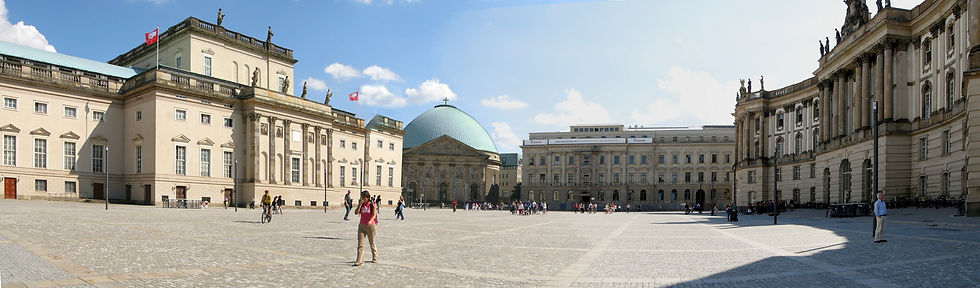
Bebelplatz
Bebelplatz

Bebelplatz is a piazza surrounded by a number of important landmarks: Unter den Linden boulevard with the State Opera (Staatsoper) to the North, Saint Hedwig's Cathedral (Sankt-Hedwigs-Kathedrale) at the Northeast, Humboldt University of Berlin (Humboldt-Universität zu Berlin) at the East and the South, and the Free University Berlin (Freie Universität Berlin) at the West behind this photograph. The two book-burning monuments are near the Southeast corner.

Memorial to the Murdered Jews of Europe (Denkmal für die ermordeten Juden Europas)

My children at the Memorial to the Murdered Jews of Europe

The Memorial to the Murdered Jews of Europe (Denkmal für die ermordeten Juden Europas) is a site covered with 2,711 concrete stelae serving as a memorial for the murdered Jews in Europe. The site used to be one of the largest Jewish community in Germany. The stelae vary in heights but with uniform length and width lying regularly.

The site is unfortunately often used as a recreational ground, including my children, due to the labyrinthic nature of the memorial. When we were there, there were a few groups playing Pokémon Go.

Bauhütte Kreuzberg

Bauhütte Kreuzberg
Bauhütte Kreuzberg

I paid a special visit to Bauhütte Kreuzberg as picture above. Bauhütte, an ICH as blogged in Strasbourg, is originally is a guild-like space where community perpetuate the construction methods and techniques of churches. The one in Berlin, near Checkpoint Charlie, has developed to the transmission of knowledge in the areas of urban development, bicycle repairs and fabrication, creative art and culture, social issues, and education. The groups hold regular meetings at the Bauhütte or on the grounds.

I spoke with the members inside the Bauhütte and somehow it is now a bit like a community centre, offering low-threshold participatory activities and educational programmes for young people to workshops, community dialogues, and curated events on urban policy issues. They currently focus more on bicycle construction and arts, but with an aim to turn the area to a cultural hub. The huts above represent different workshops offering different programmes.

Experience, Buy and Do

Berlin Wall (Berlin Mauer)

My Berlin Wall fragment

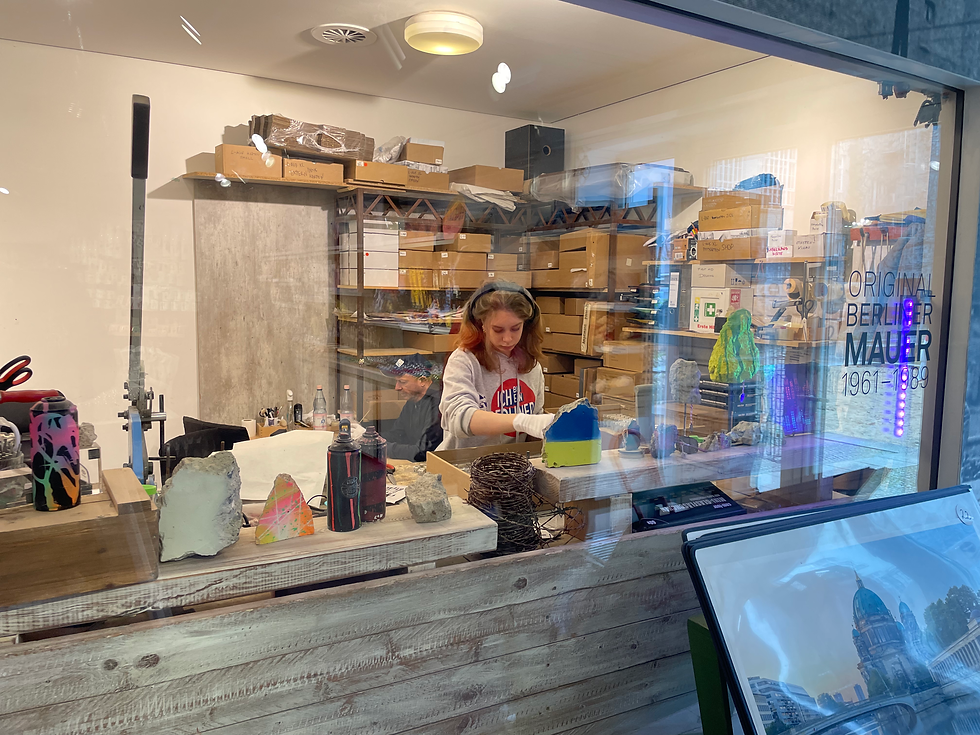
Naturally I bought a fragment of the Berlin Wall, from the official museum near Checkpoint Charlie, and it is complete with an official certificate. These come in all sizes and are Berlin tourists most popular souvenirs, some as big as a huge rubble (I wonder how someone will carry that home!). Inside the museum shop one can see how these concrete fragments are made to a souvenir. Seriously the fragment, not very expensive really is a piece of history! Also never thought the Wall actually brings Germany a fortune!

Berlin Wall fragment becoming a souvenir

Ampelmann

The other must-buy iconic souvenir in Berlin is everything Ampelmann, the traffic light man symbol previously used in East Germany. Since unification, the symbol was no longer used, but strangely enough, it has become a beloved cult symbol of East Germany and has soared in its popularity, turning it to a commercial item!

A small bit of history, the traffic light man picture actually inspired by a picture of the long-time East German ruler Erich Honecker with his hat on!

Souvenirs come in all forms as one can imagine: it was loved by my children as I bought them a packet of Ampelmann gummies, and when I wrote this blog they still recognised it!.

Ampelmann
Ampelmann

Mauerpark flea market (Mauerpark Flohmarkt)

Every Sunday there is a massive flea market in Mauerpark, which was actually the reason why I was brought to Bernauer Straße! The market is itself a joy to be part of, selling all sorts of junks, and the park also has other remnants of the Wall. My children got some cheap toy cars from the 1980s!

Mauerpark flea market
Eat and Drink

Currywurst

Our currywurst and hotdog from Currywurst 61

It turns out that the famous currywurst originates from Berlin! It was actually invented by chef Herta Heuwer just after World War II, who then sold it at food stands, and then the rest is history. The curry (Tamil: கறி, kaṟi) is really not curry as I know it, but a mixture of ketchup, curry powder and Worcestershire sauce, with all three spices coming from British soldiers in the city. It is now easily the most popular streetfood in Germany and of course I had to try it again!

We had ours from Curry 61, an extremely popular chain where every branch restaurants have a long queue! Definitely worth the wait!

Stay

We stayed at Homely Berlin-Mitte in West Berlin, which we shall blog later.

Travel Suggestions and Logistics

Berlin has one of the best metro systems in the world, as far as I know. Every tourist spot is direclty accessible either by its U-Bahn (Untergrundbahn) and S-Bahn (Schnellbahn). We stayed in Berlin for a week and paid for a six-day ticket, granting us unlimited rides in all public transport, including those to the airport.

It is advisable to get a full-day all-museum pass or a multi-day pass for the Museum Island. Each museum costs EUR 14€ while a full-day all-museum pass is 24€.

UNESCO Inscriptions
UNESCO sign
UNESCO sign
The museum as a social phenomenon owes its origins to the Age of Enlightenment in the 18th century. The five museums on the Museumsinsel in Berlin, built between 1824 and 1930, are the realization of a visionary project and show the evolution of approaches to museum design over the course of the 20th century. Each museum was designed so as to establish an organic connection with the art it houses. The importance of the museum's collections – which trace the development of civilizations throughout the ages – is enhanced by the urban and architectural quality of the buildings.
The workshop organization, or Bauhüttenwesen, appeared in the Middle Ages on the construction sites of European cathedrals. Now, as then, these workshops are home to various trades working in close collaboration. The term Bauhüttenwesen in German refers both to the organization of a workshop network dealing with the construction or restoration of a building and to the workshop itself, as a place of work. Since the end of the Middle Ages, these workshops have formed a supra-regional network extending beyond national borders. The workshops safeguard the traditional customs and rituals of their professions, as well as a wealth of knowledge transmitted across the generations, both orally and in writing. Faced with the progressive shortage of technical skills and in an age of increasing mechanization and cost optimization, the workshops created or re-established in the nineteenth and twentieth centuries have become institutions that preserve, transmit and develop traditional techniques and know-how. Their commitment to safeguarding and promoting living heritage, through targeted awareness raising, information and communication measures and close cooperation with shareholders in the field of politics, the church, monument conservation, business and research, can be considered as an example to be adapted and implemented in other contexts worldwide. Through their organization and training system for on-site practice, the workshops could be considered as a model for all types of buildings that need to be built and maintained.
References
Comments

Please share your thoughts and comments about the blog. If you need suggestions to build a travel itinerary, please let me know. More than willing to help. I would also like to build a bespoke-in-depth travel community around UNESCO WHS and ICH.


留言


100_1282.JPG
关于喵喵

一位狂热的业余旅行者,拥有一份联合国教科文组织的遗愿清单。 在他的旅行中尝试注入文化、食物和语言。 在他的现实生活中,他的职业是数学家、词源学家和算命师。


Join My Mailing List

Thanks for submitting!

© 2019 by Maximus Andrius Nostramabus through Wix.com

  • Facebook Social Icon
  • YouTube
  • Instagram
  • Blogger Social Icon
  • Trip Advisor Social Icon
  • TikTok
bottom of page