


波尔多(Bordeaux)
已更新:3小时前
月亮与美酒的经典意象 - 法国圣地亚哥—德孔波斯特拉朝圣之路 868;波尔多月亮港1256; 法国人的美食 00437;长棍面包的手工知识和文化 01883

什么和为什么
2024年,我带着家人去参与巴黎奥运会(法语:Jeux Olympiques)—不过颇具讽刺意味的是,我们实际上是待在波尔多(Bordeaux)。之所以选择这里,原因有三:首先,巴黎(Paris)届时定会人潮拥挤,且扒手猖獗;其次我想借此机会探索法国(France)的其他城市;再者我了解到波尔多格调高雅,对游客非常友好,而且美食云集。此外,波尔多周边还有两处世遗(即我在博文中的滨海勒韦尔东(Le Verdon-sur-Mer)和圣埃米利永(Saint-Émilion),加上波尔多本身),正好可以帮我完成“人生愿望清单”上的打卡目标。我们对这一选择感到无比欣喜,这次旅行也成了我们迄今为止最棒的家庭度假之一。
波尔多的文化遗产,由河流、葡萄酒与建筑石材之间的对话所构筑。在21世纪之交经历大规模城市更新之前,波尔多曾被称为“睡美人(La Belle Endormie)”。这里拥有欧洲规模最大的十八世纪建筑群之一,并以“波尔多,月亮港(英语:Bordeaux, Port of the Moon)”之名被列入世遗名录。这一名称源于加龙(Garonne)河—它呈新月形蜿蜒流经城市,宛如一道弧线环抱着波尔多的历史核心区。得益于这条河流,波尔多的身份与历史与其地理地位紧密相连:它既是一座内陆港口,又是通往大西洋及欧洲其他地区的门户。该港口以葡萄酒贸易为主导,正是这种著名的葡萄酒贸易,让波尔多享誉全球。波尔多的财富积累主要始于并得益于葡萄酒贸易,同时也涉及糖、咖啡、可可、棉花和靛蓝(indigo)等殖民(英语:colonisation)地商品;但令人遗憾的是,这一过程中也曾不幸地卷入了跨大西洋奴隶贸易。

地名
与普遍的认知不同,“波尔多”一词并非源自“bord d'eaux(意为“水之边缘”,指代加龙河及吉伦特河口(estuaire de la Gironde))”。这属于一种“民间词源”解释:虽然听起来颇为巧妙,但纯属巧合,在语言学上并不准确。
“波尔多”一名实际上源自古高卢-罗马(英语:Gallo-Roman)时期的名称“Burdigala”。该词历经古奥克语(Bordel)和奥克语(Bordèu)的演变,进入中古法语(Bordeaulx),最终演变为如今的“波尔多”。其中,词干“burd-”在原始凯尔特语中意为“泥泞”或“沼泽”,而“-gala”则意为“海湾”。因此,“波尔多”的本义即为“泥泞的海湾”。
看
我们在那里待了一周,基本上是按照官方推荐的步行游览路线进行的。但我完全不同意将其称为“步行游览”,因为这座城市里值得看的东西实在太多了。我们把行程分成了三四天来完成—毕竟我们还带着四个年幼的孩子呢。
梅花广场(Place des Quinconces)
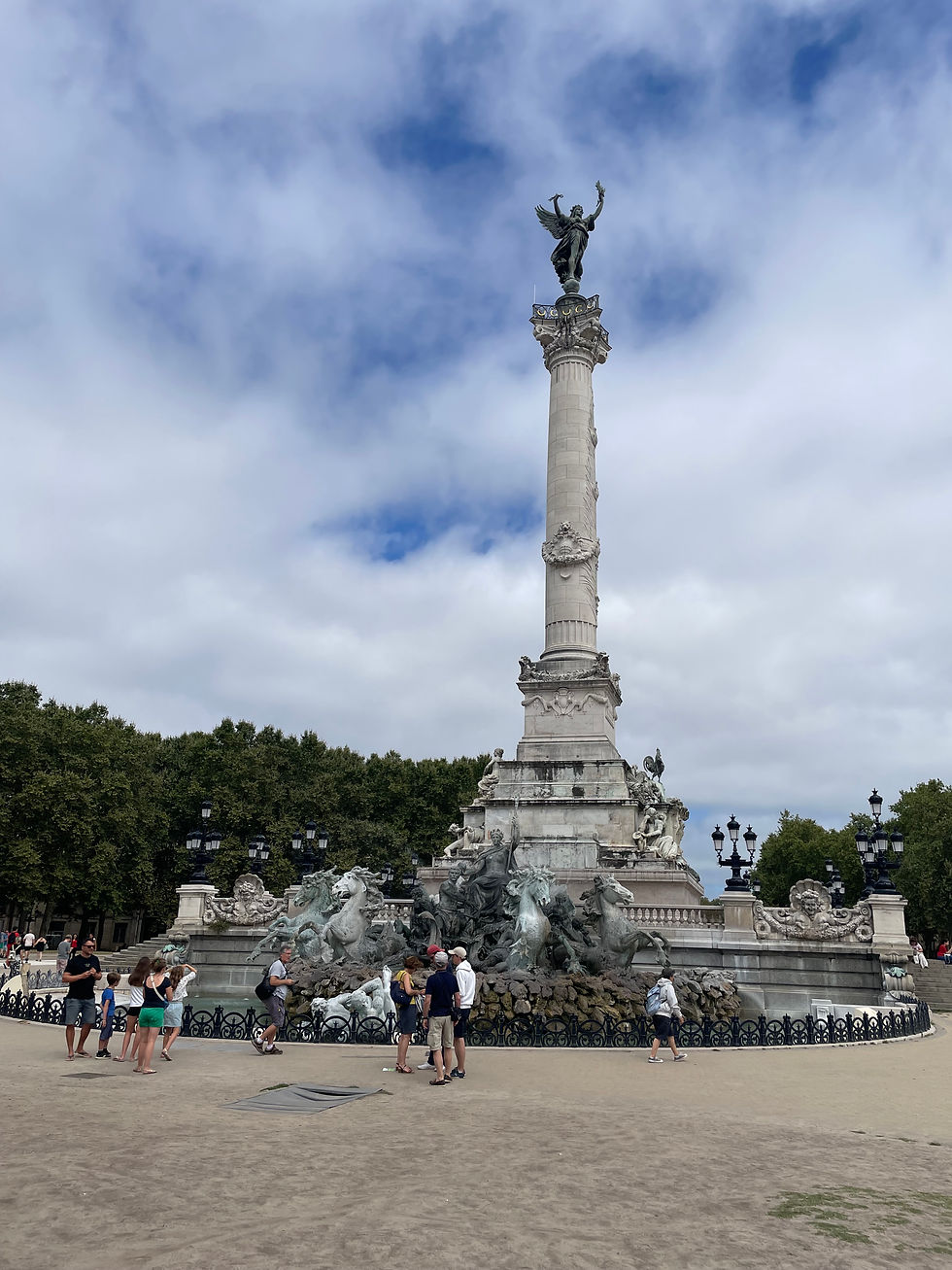
梅花广场(Place des Quinconces)是我们抵达波尔多后见到的第一个地标,无疑也是这座城市最具代表性的中心开放空间。其名称源于最初种植树木时所采用的“梅花形(quinconce)”排列方式。该广场所在地原为“特龙佩特城堡(Château Trompette)”—一座曾用于王室掌控城市的堡垒。这里转变为宽阔的公共广场,标志着一种精神内核的转变:从封闭的堡垒走向了开放。

该区域乃至整座城市最主要的地标,便是上图所示、风格华丽的“吉伦特派纪念碑(Monument aux Girondins)”。这座纪念碑建于十九世纪末,旨在向法国大革命(Révolution française)期间被处决的“吉伦特派(girondins)”成员致敬,同时也纪念法兰西共和国。吉伦特派是一个重要的政治派别,因其与吉伦特省(Gironde,波尔多即为该省省会)的渊源而得名。这座纪念碑的设计体现了波尔多如何通过其独特的政治身份来铭记那场革命:它由一座高耸的立柱构成,立柱下方设有喷泉底座,顶端则矗立着一尊象征“自主神(Libertas)”的青铜雕像。
纪念碑底座处设有两座宏伟的青铜喷泉,其上装饰着寓意深远的雕塑群。面向河流的一侧是“共和国的胜利(Le Triomphe de la République)”,雕塑描绘了一辆由骏马牵引的战车,象征着力量、活力与进步,正驱散着无知、恶习与罪恶。另一侧面向西方的则是“和谐的胜利(Le Triomphe de la Concorde)”,象征着和平与融洽,同时也寓意着对商业、农业及和平的守护。第二次世界大战期间,这些雕塑曾被德军拆除,意图将其熔化以制造武器。然而,在法国解放后,人们在昂热(Angers)找回了这些完好无损的雕塑,并于1983年将它们重新安装回原处。
广场本身常用于举办各类公众集会、市集及活动;广场的一侧还是波尔多市有轨电车系统的核心换乘枢纽。

戈比诺公馆(Maison de Gobineau)

从梅花广场步行片刻,即可抵达戈比诺公馆(Maison Gobineau)。这是一座位于历史中心边缘、造型独特的三角形高层建筑,其现代化的外观与周边石质外墙形成了鲜明对比。该建筑与葡萄酒贸易有着密切联系:它是波尔多葡萄酒行业协会(Conseil Interprofessionnel du Vin de Bordeaux)的所在地,该协会是代表当地葡萄酒行业的专业机构。
大剧院(Grand Théâtre)

附近矗立着大剧院(Grand Théâtre),这是波尔多最重要的新古典主义(英语:neoclassicism)地标之一。我们在那里度过了近半个下午(在烈日炎炎下,这里简直是一个绝佳的避暑胜地,而且还有冷气!)。该建筑最初的设计初衷是兼作公共纪念建筑与演出场所,内部设有剧场及各类展厅;不过在起初阶段,它主要服务于富裕阶层。其建筑风格彰显了波尔多力争成为法国重要文化枢纽的雄心—宏伟的立面饰有列柱,配以宽阔的台阶和精美的雕塑。
剧院入口处由十二根科林斯柱(英语:Corinthian order)环绕,柱顶矗立着象征“缪斯(希臘語:Μουσαι)”女神的雕像,将这座建筑与艺术、美、知识以及文明素养等理想联系在一起。如今,这里依然是波尔多国家歌剧院(Opéra National de Bordeaux)的所在地。

我们原本计划去剧院看几场演出,装装样子,显得高雅有品位。可惜我们忘了法国艺术家夏天不工作…
大剧院外面还有另一个不错的聚会场所。外面的广场叫喜剧广场(Place de la Comédie),那里文化和商业活动丰富多彩,热闹非凡。我儿子只在旋转木马上玩。

交易所广场(Place de la Bourse)

波尔多建筑中的瑰宝,当属交易所广场(Place de la Bourse)。该广场由昂热-雅克・加布里埃尔(Ange-Jacques Gabriel)设计—他也是巴黎协和广场(Place de la Concorde)的设计者—其建造初衷是为了拆除中世纪的城墙,让波尔多城向加龙河敞开怀抱。
广场两侧矗立着两座对称的建筑,隔着中央庭院遥相呼应。南侧建筑原为“税务大楼(Hôtel des Fermes)”,曾用于征收皇家关税与税款,如今这里是国家海关博物馆(Musée National des Douanes)的所在地。北侧建筑则是“证券交易所大楼”(Hôtel de la Bourse),曾作为城市的证券交易所和商会使用。
建筑中央的三角楣饰上装饰着雕塑,歌颂着波尔多繁荣的国际贸易。广场中央曾矗立着一座路易十五(本名 Louis de Bourbon)的骑马雕像,但后来雕像被熔化,用作铸造大炮的金属原料。十九世纪中叶,这里建起了“三美神喷泉(Fontaine des Trois Grâces)”。喷泉上的三位女神是宙斯(希腊语:Ζεύς)的女儿:象征美丽与优雅的阿格莱亚(希腊语:Ἀγλαΐα)、象征欢乐的欧佛洛绪涅(希腊语:Εὐφροσύνη),以及象征丰饶的塔利亚(希腊语:Θάλεια)。
我们在北侧建筑里待了许久—当时这里被临时改造成了宣传奥运会的旅游咨询处,我们也正好借此躲避热浪。
证券交易所广场正对着加龙河岸,如下图所示。

水镜(Miroir d'Eau)
我们首日行程的一大亮点,无疑是位于交易所广场正前方的“水镜(Miroir d'Eau)”。看看我儿子就知道了—他一到那儿,立刻脱得精光,又蹦又跳,嘴里还哼着《小猪佩奇(英语:Peppa Pig)》里的歌。这处水池建于2006年,是滨水区改造项目的一部分;它也是全球最大的反射水池,由黑色花岗岩铺就,总面积达四千四百五十平方米。水池的设计十分巧妙:它时而铺满一层浅浅的水,宛如镜面,映照出交易所广场十八世纪的建筑立面;时而排干积水,转而喷洒出层层水雾,让整个水池笼罩在一种如梦似幻、朦胧通透的氛围之中。在浅水状态下,它能近乎完美地倒映出交易所广场的建筑;而当水雾升起时,那些熟悉的建筑立面便变得若隐若现,甚至还会映现出彩虹。

我儿子在泳池里玩得特别疯,其他大多数孩子也一样。顺便提一下,上面那张主图确实是我用 Iphone 拍的—其实没那么难,当然我事先确实从专业人士那里讨教了一些技巧。只要趁人少时早点去,等阳光正好时按下快门就行了。那些黑色板材可是起到了关键作用!
议会广场(Place du Parlement)
从交易所广场出发,我们步行前往议会广场(Place du Parlement),本以为会看到当地的议会机构,结果却发现这里不过是又一个洛可可(Rococo)风格的小广场。该广场原名“皇家市场广场(Place du Marché Royal)”,四周环绕着整齐划一的三层石灰岩建筑;建筑底层设有拱廊,外立面则装饰着锻铁阳台和面具雕饰(mascarons)。如今,这里已成为一处旅游广场,遍布着各类餐厅、小酒馆和商店。

凯约门(Porte Cailhau)
接下来的两天,我们探索了波尔多那些更具工人阶级气息和宗教色彩的街区,这与我们第一天所见的那些更偏向资产阶级(bourgeoisie)、格调高雅且属于上流阶层的地标形成了鲜明对比;不得不说,这段经历同样令人大开眼界。
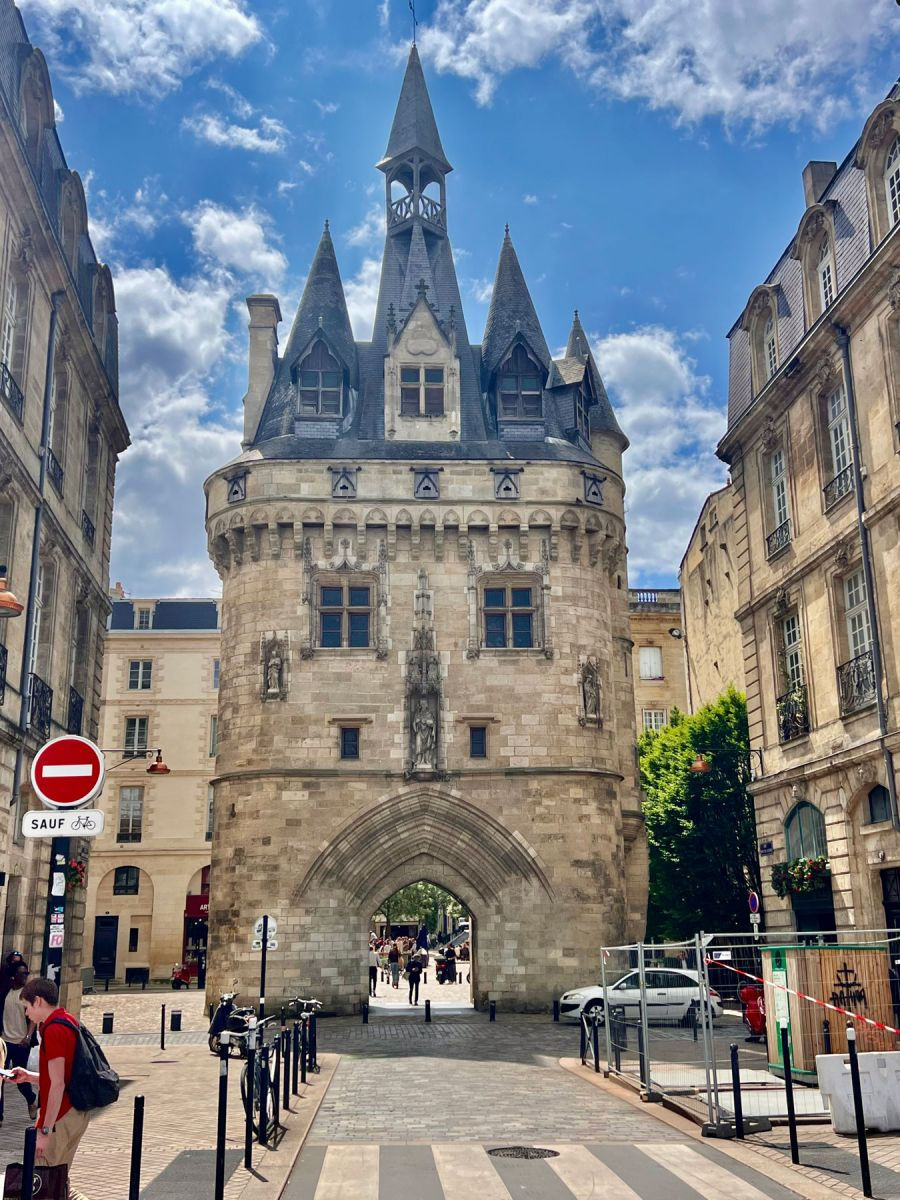
凯约门(Porte Cailhau)矗立在老城区与加龙河码头的交汇处,建于十五世纪末,是当时城墙体系的延伸部分。这座城门旨在纪念查理八世(Charles VIII,本名 Charles Valois)国王在福尔诺沃战役(意大利语:Battaglia di Fornovo)中战胜意大利同盟军的胜利;它既具备军事防御建筑的特征,又融合了多种文艺复兴(Renaissance)时期的装饰元素。凯约门高三十五米,既是守护河岸的防御塔楼,也是进入城市的门户。
“凯约门”这一名称在加斯科涅方言中意为“鹅卵石”;其历史与旧宫殿区以及中世纪城市的政治生活紧密相连。城门周边区域已发生了巨大变化:昔日的旧港口早已不复存在,取而代之的是专为散步和举办公共活动而设计的滨河码头。尽管如此,凯约门依然标示着一条历史界线,向游客诉说着昔日河岸的位置,以及这里曾作为城市人员往来与船只停靠的主要枢纽的历史。
勃艮第门(Porte du Bourgogne)

在历史城区的东缘,矗立着勃艮第门(Porte de Bourgogne)。这是一座建于十八世纪的凯旋门,坐落于多条主要道路的交汇处。该门同样由加布里埃尔设计,旨在作为通过旧路网进入城市的宏伟入口,面向东侧的来路以及横跨加龙河的桥梁。其建筑风格采用古典且质朴的多立克式(英语:Doric)造型,旨在框定向东眺望河对岸拉巴斯蒂德(La Bastide)街区的视野。这座城门位于比尔-阿凯姆广场(Place Bir-Hakeim),由此可进入城市的工人阶级居住区—该区域环境确实显得有些杂乱,与附近水岸边的高档街区及交易所广场形成了鲜明对比。
这座城门是以法国王太子、勃艮第公爵路易(Louis,Duc de Bourgogne,本名 Louis de Bourbon)的名字命名的,他是国王路易十五的孙子。
圣弥额尔圣殿(Basilique Saint-Michel)

圣弥额尔圣殿(Basilique Saint-Michel)以其宏伟的钟楼,在比尔-阿凯姆广场附近的街区中格外引人注目;钟楼高耸于一片密集的区域之上,周围环绕着集市、商店、咖啡馆和居民区。这座教堂历经数世纪建成,是波尔多规模最大的宗教建筑之一。其钟楼被称为“圣米歇尔尖塔(Flèche Saint-Michel)”,与教堂主体建筑分离,是法国第二高的哥特式(德语:Gotik)尖塔。
该大教堂是法国境内通往圣地亚哥-德孔波斯特拉(Santiago de Compostela)的朝圣之路(即著名的“圣雅各之路(Camino)”)上的一个重要站点,正如圣地亚哥-德孔波斯特拉(Santiago de Compostela)的博客所写。大教堂建于十四至十六世纪之间,是“火焰哥特式(Flamboyant)“建筑风格的杰出典范。教堂内部空间宏大,设有17座侧礼拜堂;此外,这里还有一座虽小却精美的石雕讲坛,上面雕刻着圣米迦勒(希伯来语:מיכאל)斩杀恶龙的场景。

波尔多主教座堂(Cathédrale Saint-André)

穿过圣弥额尔圣殿附近的一些狭窄街道,我们径直前往“圣雅各之路”上的另一个站点。波尔多主教座堂(Cathédrale Saint-André)是一座重要的哥特式教堂,长期以来既是宗教中心,也是城市公共生活的枢纽。其建筑历经数世纪逐渐建成,因此整座建筑留下了不同时代风格演变与各阶段施工的印记。

根据标牌,与大教堂相关的最重要的事件之一是阿基坦(Aquitaine)的埃莉诺(Aliénor,本名 Alienòr Ramnulfids)与路易七世(Louis VII,本名 Louis Capet)于1137年结婚。尽管该地区与君主政体之间的政治关系会反复变化,但这次结合实际上将阿基坦与法国联系在一起。 波尔多的历史在法国和英格兰(England)之间不断变化,特别是在阿基坦长期处于英国统治之下。 因此,大教堂不仅是一座宗教建筑,而且是这座城市不断变化的政治地理的见证。
与圣米歇尔大教堂一样,大教堂也有一个远离大教堂的独立钟楼,称为 Tour Pey-Berland。 它与大教堂的分离通常是因为地面不稳定以及保护教堂结构免受钟声振动的影响。
从那里,我们在大教堂外吃了一顿早饭,然后前往观看奥运会足球比赛,稍后将进行讨论。
费尔南-拉法尔格广场(Place Fernand-Lafargue)
费尔南-拉法尔格广场(Place Fernand-Lafargue)位于两座大教堂之间,步行片刻即可到达。自中世纪以来,这里一直是波尔多的商业中心,这一地位延续至今。除了作为鱼类、肉类和当地农产品的交易市场外,该广场过去还曾是执行公开司法惩罚的场所,其中包括使用枷刑柱(示众刑具)。如今,枷刑柱早已不复存在,该区域已演变为波尔多主要的商业街和美食街之一—我们在此期间也曾在这里享用过几顿餐点。广场周边环绕着相当狭窄的街道,是体验咖啡文化和当地夜生活的好去处。我与几位来自波尔多大学(Université de Bordeaux)的朋友相约在此,他们当时提议就在这里共进午餐。

大钟门(Grosse Cloche)
大钟门(Grosse Cloche)是中世纪波尔多最醒目的遗迹之一。这座城门兼钟楼曾是旧城墙与市政厅建筑的一部分,也是穿过防御工事的通道。现存建筑保留了历史悠久的城门和一口大钟。按照传统,这口大钟会在以下日期的上午11点鸣响:1月1日(元旦)、5月1日(劳动节)、5月8日(欧洲胜利日)、7月14日(国庆日)、8月28日(二战期间波尔多解放纪念日)、11月11日(老兵节,一战停战纪念日),以及每月第一个星期日。此外,在举行公共庆典或重大市政活动(例如葡萄采收季(vendanges)的开始)时,大钟也会鸣响。

这口钟铸造于1775年,绰号“阿曼德-路易丝(Armande-Louise)”,重达近七千八百公斤。这个名字让我想起了“大本钟(英语:Big Ben)”—正如我在“伦敦 (London)|西”博文中所提到的那样。
罗昂宫(Palais Rohan)

这一宗教主题的参观行程以罗昂宫(Palais Rohan)作为终点—该建筑如今是波尔多的市政厅(hôtel de ville)。它巍然屹立,与波尔多主教座堂隔街相望。罗昂宫建于18世纪,最初是大主教 Ferdinand-Mériadec de Rohan 的官邸,见证了教会昔日在波尔多的雄厚财力与巨大影响力。
当代艺术博物馆(Musée d'Art Contemporain)
在参观了几天历史古迹之后,我们在波尔多的最后两天里,转而探访了一些更具现代感和科技气息的地标。我们参观的第一个地方是当代艺术博物馆(Musée d'Art Contemporain)。馆内空间相当宽敞,设有多个展区。不过由于我们俩对艺术并不怎么在行,便只是在馆内随意逛逛,顺便享受一下空调。而且,多亏我会说法语,我还成功为大家争取到了门票优惠!

潜艇基地(Base Sous-marine)

潜艇基地(Base Sous-marine)属于波尔多历史上一个截然不同的篇章。它由二战期间的德国占领军建造,曾是支持大西洋军事行动的潜艇基地。这座建筑规模宏大,是一座由厚重防护墙构成的庞大混凝土结构,内设多个潜艇停泊位,其顶部设计旨在抵御空袭。由于其巨大的钢筋混凝土体量,拆除工程在经济上极不划算;因此战后多年里,它一直作为战争遗迹矗立在那里,显得格外突兀,无论在政治还是经济层面,都难以融入城市的公共生活之中。
后来,一个巧妙的构想让它摇身一变,成为了一处广受欢迎的文化展馆。如今,该建筑的一部分被改建为“光池(Bassins des Lumières)”—一个沉浸式数字艺术中心。投影影像与声效充盈着巨大的空间和水池,巧妙利用了建筑本身的宏大尺度,营造出一种非同寻常的展览环境。这里变得非常现代且充满乐趣,连我的两个年幼孩子也乐在其中。我们在内部的迷宫中穿行,观看了一场关于太空的主题展览;各种与太空相关的影像和动画投射在每一面墙壁上,构建出一种超维度的视觉体验。绝对值得一游。
葡萄酒与葡萄酒贸易博物馆(Musée du Vin et du Négoce)

根据个人偏好的不同,其实有两个选择:一个是风格较为传统的葡萄酒与葡萄酒贸易博物馆(Musée du Vin et du Négoce),另一个是位于历史中心外围、极具现代感的葡萄酒城(Cité du Vin)。我们选择了前者,因为它更古朴,且距离市中心更近。我妹妹在酒店业工作,她两个都去过,也更倾向于前者。
交流之后,我们一致认为自己的选择是对的,因为我们更想探寻那种地道(尽管难免带有些许人工修饰)、质朴且充满历史感的酒窖。我个人特别希望能深入了解波尔多的贸易史,而这次参观也确实让我收获颇丰。在我看来,这是了解这座城市葡萄酒文化底蕴的最佳方式,而且票价也亲民得多。至于“葡萄酒城”—其建筑外观酷似一个醒酒器—则更适合那些只想走马观花、偏好科技感或追求高端体验的游客。
经历,活动
皮拉沙丘(Dune du Pilat)

我们从波尔多出发,驱车约一小时,抵达了附近的沿海小镇阿卡雄(Arcachon),皮拉沙丘(Dune du Pilat)便坐落于此。皮拉沙丘是欧洲最高的沙丘,海拔超过一百米,绵延在法国西南部大西洋沿岸的海湾入口处。历经数千年,在海风和潮汐的作用下,数百万立方米的细沙堆积形成了这一宏伟的地质景观;它宛如一道天然屏障,横亘在大西洋与朗德森林(Landes de Gascogne)之间。
在沙丘上行走或攀登十分费力,每走一步,双脚都会深深陷入沙中。不过,无论是通过台阶还是直接攀爬沙坡抵达顶峰,都能收获绝佳的三百六十度全景视野—一边是大西洋的浩瀚,另一边则是连绵的森林。景色令人惊叹。
正如上图所示,从沙丘顶端下来最轻松的方式就是滑下去。我的侄子和儿子玩得不亦乐乎,对他们来说这纯粹是种乐趣;但对我而言却并非如此:滑完之后,我得费劲地清理掉儿子身上所有的沙子,否则这些沙子恐怕会弄得我们住处到处都是。
在前往沙丘之前,我们还逛了逛比尔-阿凯姆广场外的一个周末跳蚤市场。

如前所述,我们此行波尔多的目的,就是为了观看奥运会。我们在翻新后的波尔多大西洋体育场(Stade Atlantique Bordeaux Métropole)观看了一场足球赛,让家人能够亲身感受奥运精神与氛围。比赛结果如何,对我家人和随行伙伴们来说并不重要,但大家确实都乐在其中!
吃喝
Bordeaux wine (Vin de Bordeaux)
Let us be honest, Bordeaux is all about its wine! The cultural identity of Bordeaux is inextricably tied to its wine production. The Bordeaux wine region encompasses over more than 1,000 km² of vineyards, producing predominantly red wines along with dry whites, and sparkling wines. As blogged in Le Verdon-sur Mer, we spent a good afternoon exploring many of the renowned châteaux of the region, and my wife who is still a certified sommelière, was able to explain to me, a non-drinker, everything about it. So this section is pretty much her input, and you can imagine she was pretty proud about it.

The viticultural landscape of Bordeaux is geographically bisected by the Garonne and Dordogne rivers, which converge to form the Gironde Estuary. This hydrological network splits the region into three distinct zones:
The left bank (Rive gauche: Médoc and Graves): Situated west of the Garonne and Gironde. The well-drained gravel soils retain heat, making them ideal for ripening late-ripening varieties, principally Cabernet Sauvignon. Almost all the main châteaux we visited mull this grape specie.
The right bank (Rive droite: Libournais): Situated east of the Dordogne, encompassing the blogged Saint-Émilion, Pomerol, and Fronsac. The soil profiles feature cooler, moisture-retentive clay and limestone mixtures. These soils favour early-ripening varieties, principally Merlot and Cabernet Franc.
Entre-Deux-Mers: The rolling hills situated between the Garonne and Dordogne rivers, dominated by clay-limestone soils utilised for dry white wines like Sauvignon Blanc, Sémillon and other accessible reds.
The above grape varieties are the major ones found in the three regions around Bordeaux.
Historically, the port helped Bordeaux wines become internationally known. Trade with the British Empire became especially important after Eleanor of Aquitaine, mentioned above, became Queen of England when she remarried with Henry Plantagenet, later Henry II, in the 12th century. English demand helped establish and start enduring international commercial links.
As time goes by, Bordeaux wine became internationally famous and a standard was needed to adjudge the quality and value of the produce. In came Napoloen III (né Charles Bonaparte) when he ordered the establishment of the Classification 1855, produced for the Exposition Universelle in Paris, which effectively became the gold standard of most Bordeaux wines. It continues to shape perceptions of prestige, although it covers only part of the region and does not even represent the full diversity of Bordeaux. There are other appellations and classification systems, like the blogged Saint-Émilion having their own histories and standards. The classification is best understood as one of reputational instrument in the commercial history of wine, rather than an actual measure of wine quality.
The list ranked 61 red wines of the region into five tiers of First Growths (Premier Grand Crus Classé) to Fifth Growths (Cinquièmes Crus Classé). In particular the First Growths come only from the five prestigious estates of Château Lafite Rothschild, Château Latour, Château Margaux, Château Haut-Brion and Château Mouton Rothschild, all of those we had visited except Château Haut-Brion in Pauillac without realising beforehand! A similar ranking exists parallel for the white wines.
Bordeaux wine is not only about its quality but its wine trade is equally culturally significant. The trade has relied on a distinctive network of growers, négociants and courtiers. Growers cultivate grapes and make wine. Négociants buy and sell wine, and may also blend, bottle or market it. Courtiers or brokers, connect producers and merchants and facilitate transactions. These block-chained roles have changed over time, but their interaction remains part of the region’s wine special identity.
Hence the experience in Bordeaux should not only be appreciated via tasting, but a deeper understanding comes from asking how the wine was made, who made it, what the label means and what the surrounding landscape contributes. Tasting should definitely not merely a test of expensive bottles, and the French do make an occasional mockery of the many questionable investments and purchases of the vineyards of the region.
Steak and fries (Steak-frites)

The entrecôte is a classic bistro preparation consisting of a ribeye steak cooked over dried grapevine cuttings (sarments), which produce intense heat and a subtle smoky aroma. The steak is served with the restaurant signature Bordelaise sauce, red wine, shallow-fried shallots, butter, herbs, black pepper, and poached beef bone marrow (moelle).
This plate is served in one institution called L'Entrecôte and this restaurant is built around a strict, single-dish concept that has remained virtually unchanged since the brand's founding in 1959. What makes thus Bordeaux restaurant and its specific dining ritual distinctive comes down to a few key perhaps quirky elements. For one there is no choice, except for dessert. When we sat down, the server asked only two questions about how would the steak be cooked and what to drink. Every diner receives the exact same fixed meal. The main course of steak is standard 170 g of trimmed, thinly sliced sirloin (faux-filet, despite the name entrecôte) served with French fries. No size difference.
The service is also universally served in two stages: To prevent the thin slices of steak from going cold while you eat, the kitchen divides your portion into two servings. The server places the first half of the meat and a pile of fries on your plate, while the remaining steak stays warm on a heated silver platter at your table. Once you finish the first round, the server returns to plate the second half along with a fresh batch of unlimited fries.
The restaurant also operates strictly on a walk-in basis and no one is exempted from the excessively long waiting line, unless one chooses to eat during an unusual hour.
The restaurant is part of the original French family-run chain by the descendants of Henri Gineste de Saurs. All of its restaurants features unmistakable trademark yellow-and-black striped awnings, bright yellow paper tablecloths, and waitresses dressed in yellow blouses with black aprons.
Above is our picture in queue.
Oyster (Huître)

Arcachon is famous for its oysters, given its proximity to the coast. Oysters from Arcachon are served raw on the half-shell over ice, accompanied by fresh lemon, red wine vinegar with minced shallots, salted butter and hot crépinettes, small pork sausages wrapped in caul fat. This oyster serving is a cornerstone of the regional culinary tradition. We had our oysters in Chez Jean-Mi.
Stay
We stayed for the first time with another family and my sister in an Airbnb house called Le Bouscat. Easily one of the best Airbnb I have ever stayed in: the house was beautifully decorated; the host was very hospitable and responded promptly when requested; and the place was right in front of the tramline along one of the main roads. During the few days of heat waves, our family was just happy to stay inside the house. Just check the website yourself. Highly recommended.
Travel Suggestions and Logistics
Bordeaux is served by its own international airport and the city itself is fully connected by its own trams. Almost every landmarks described are accessible by foot or tram. We stayed in Bordeaux for a full week with excursions to Le Verdon-sur Mer, Saint-Émilion and various vineyards.
UNESCO Inscriptions
Santiago de Compostela was the supreme goal for countless thousands of pious pilgrims who converged there from all over Europe throughout the Middle Ages. To reach Spain pilgrims had to pass through France, and the group of important historical monuments included in this inscription marks out the four routes by which they did so.
The Port of the Moon, port city of Bordeaux in south-west France, is inscribed as an inhabited historic city, an outstanding urban and architectural ensemble, created in the age of the Enlightenment, whose values continued up to the first half of the 20th century, with more protected buildings than any other French city except Paris. It is also recognized for its historic role as a place of exchange of cultural values over more than 2,000 years, particularly since the 12th century due to commercial links with Britain and the Low Lands. Urban plans and architectural ensembles of the early 18th century onwards place the city as an outstanding example of innovative classical and neoclassical trends and give it an exceptional urban and architectural unity and coherence. Its urban form represents the success of philosophers who wanted to make towns into melting pots of humanism, universality and culture.
The gastronomic meal of the French is a customary social practice for celebrating important moments in the lives of individuals and groups, such as births, weddings, birthdays, anniversaries, achievements and reunions. It is a festive meal bringing people together for an occasion to enjoy the art of good eating and drinking. The gastronomic meal emphasizes togetherness, the pleasure of taste, and the balance between human beings and the products of nature. Important elements include the careful selection of dishes from a constantly growing repertoire of recipes; the purchase of good, preferably local products whose flavours go well together; the pairing of food with wine; the setting of a beautiful table; and specific actions during consumption, such as smelling and tasting items at the table. The gastronomic meal should respect a fixed structure, commencing with an apéritif (drinks before the meal) and ending with liqueurs, containing in between at least four successive courses, namely a starter, fish and/or meat with vegetables, cheese and dessert. Individuals called gastronomes who possess deep knowledge of the tradition and preserve its memory watch over the living practice of the rites, thus contributing to their oral and/or written transmission, in particular to younger generations. The gastronomic meal draws circles of family and friends closer together and, more generally, strengthens social ties.
The baguette is the most popular kind of bread enjoyed and consumed in France throughout the year. The traditional production process entails weighing and mixing the ingredients, kneading, fermentation, dividing, relaxing, manually shaping, second fermentation, marking the dough with shallow cuts (the baker’s signature) and baking. Unlike other loaves, the baguette is made with only four ingredients (flour, water, salt and leaven and/or yeast) from which each baker obtains a unique product. Baguettes require specific knowledge and techniques: they are baked throughout the day in small batches and the outcomes vary according to the temperature and humidity. They also generate modes of consumption and social practices that differentiate them from other types of bread, such as daily visits to bakeries to purchase the loaves and specific display racks to match their long shape. Their crisp crust and chewy texture result in a specific sensory experience. The baguette is consumed in many contexts, including during family meals, in restaurants, and in work and school cafeterias. The production process is primarily transmitted through work-based training, combining school courses with work experience in a bakery. This apprenticeship enables future bakers to acquire the necessary knowledge of the ingredients, tools and process.
References
Gastronomic meal of the French | UNESCO Intangible Cultural Heritage
Comments
Please share your thoughts and comments about the blog. If you need suggestions to build a travel itinerary, please let me know. More than willing to help. I would also like to build a bespoke-in-depth travel community around UNESCO WHS and ICH.


留言