


順化(Huế)
已更新:3小时前
越南的中式皇城 - 顺化历史建筑群 676; 越南宫廷音乐 00074

什么和为什么
顺化(越南语:Huế)位于越南(Việt Nam)中部,曾是十八世纪中叶“广南国(Đàng Trong)”的都城,也是十九世纪初至1945年间阮(Nguyễn)朝的皇都。顺化见证了越南建筑、宫廷音乐、烹饪艺术及城市规划的黄金时代;其城市规划深受东方哲学与风水思想的影响。然而,这座城市也经历过一段悲惨的历史:在越南战争(Chiến tranh Việt Nam)期间,越共(Việt Cộng)曾攻占并控制了顺化二十四天,期间约有三千人因被怀疑同情南越政权而遭到屠杀。
顺化最主要的景点是那座宏伟的十九世纪皇城(hoàng thành)。它由护城河与厚实的石墙环绕,内含昔日皇帝的居所。整座皇城的格局与中国的紫禁城十分相似。无论是整座城市还是皇城本身,都深受中国文化的影响,堪称中国人(及中华文化)在越南发展历史的缩影。阮(Nguyễn)氏是越南最后一个皇室家族,时至今日,仍有至少三分之一的越南人沿用这一姓氏。
对我而言,顺化是一个能让人沉思、节奏舒缓的绝佳目的地。皇城内宏伟的古迹令人联想到昔日宫廷的礼仪与威严,而历代皇帝的陵寝则展现了他们各自对自身历史地位的构想。城内的佛教寺庙营造出一种宁静的精神空间;而当地的美食则体现了一种精致的烹饪传统—它融合了宫廷的考究、本土的食材以及独特的地域风味。
地名
在越南语中,“Huế”意为“平稳的转变”;该词源自历史名称“Thuận Hóa(順化)”,两者含义相同。
看
皇城(Đại Nội)
“大内”(Đại Nội)一词源自汉语,意为“巨大的内部区域”。这里曾是越南的皇家行政中心,也是顺化最主要的旅游景点。该建筑群规模宏大,涵盖了寺庙、亭台、护城河、城墙、城门、商铺、博物馆和展馆。其中展示了越南历史上各个时期的艺术品与服饰,体现了深厚的中国文化影响—尤其是对北京紫禁城的借鉴。十九世纪初,在咨询了中国风水师的意见后,嘉隆帝(本名 Nguyễn Phúc Ánh)下令修建了这座皇城,并于1802年正式确立了阮(Nguyễn)朝。根据中国传统习俗,皇城正门朝南,并与香江(Hương Giang)的走向相呼应。此外,它位于越南中部,具有重要的战略军事意义,且便于通往沿海贸易航线。在嘉隆帝之后,历代继任者继续将其建设为政治中心、儒家思想传播地、宗教赞助中心以及举行皇家典礼的场所,这些举措对越南文化产生了深远且持久的影响。
在皇城内,我们随处可见中国文化与儒家思想的印记—无论是建筑等“硬件”设施,还是文化等“软件”层面,皆是如此。通过馆内的陈列与文物,我们了解到,越南的科举制度及官僚体系理念均沿袭了中国的传统。同样,宫廷音乐、礼服、绘画、诗歌、木工艺及漆器等,也都是在皇家赞助下发展起来的,展现出一种高度成熟的文化形态。

Enclosed by a 10-km moat and massive stone ramparts built in the Vauban style of military fortification, the citadel contains three nested walled zones:
Main Citadel (Kinh Thành): The outermost perimeter houses administrative quarters, historic residences, and broad avenues framed by ancient trees.
Royal Citadel (Hoàng Thành): Accessed through the iconic royal gate Ngọ Môn (Chinese: 午門, wumen), meaning 'meriodonal gate' picture above, a two-storey structure featuring five entrances. The central entrance was reserved exclusively for the Emperor. Above sits the Five-Phoenix Pavilion (Lầu Ngũ Phụng), where the Emperor issued decrees and where the last emperor, Bảo Đại (né Nguyễn Phúc Vĩnh Thụy), abdicated in 1945.
Purple Forbidden City (Tử Cấm Thành): the innermost sanctuary was reserved for the Emperor, the Empress, royal concubines, and eunuchs. Heavily damaged during conflicts in 1947 and 1968, ongoing restoration projects continue to rebuild key residential complexes like the Mandarin Palace (Điện Kiến Trung) and the Royal Theatre (Duyệt Thị Đường).
The Ngọ Môn was built in 1833 by Emperor Minh Mạng (né Nguyễn Phúc Đảm) and as mentioned was reserved exclusively for the emperor. The gate opens to Thái Hòa Palace, meaning 'Great Rites Courtyard and Palace of Supreme Harmony'. The architecture combines a strong sense of symmetry with the elegance of traditional Vietnamese rooflines.
This was not simply a convenient doorway. Gates in imperial capitals communicated rank and authority through their dimensions, decorative treatment and permitted uses. The central passage was reserved for the emperor, while other entrances served different categories of people and ceremonial purposes.

The interior of Thái Hòa Palace shows traditional extravagant design: richly coloured columns, gilded ornament, dragon motifs and carefully arranged interior communicate the emperor's elevated position within the political order.
The dragon was especially important in imperial iconography typical of Chinese traditions. It represents power, auspiciousness and divine authority. In Huế, dragon imagery became closely associated with the monarchy, appearing on roofs, furnishings, textiles and ceremonial objects.

Just north of the Purple Forbidden City, which is now completely destroyed, is the Mandarin Palace, which is seriously palatial and beautiful. One of the exhibits documents Vietnamese ownership of the disputed Spratly Islands (Quần Đảo Trường Sa) through various historic maps, certain to enrage Chinese tourists.

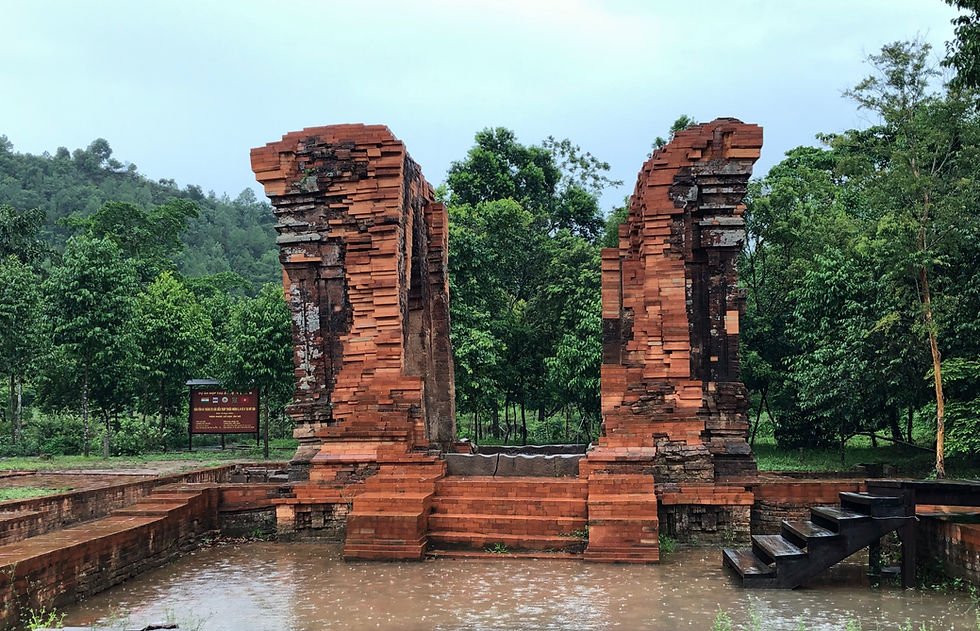
The picture below shows the totally ruined Purple Forbidden City, thanks to the Vietnam War.

Inside the Mandarin Palace, one of the most important exhibits are the Nine Dynastic Urns (Cửu Đỉnh). Cast in bronze between early 19th century, these massive urns represented the stability of the Nguyễn Dynasty. Each urn is carved with intricate relief patterns depicting Vietnam’s landscapes and sea vessels.
The Mandarin Palace corridor that we spent almost an hour because of the torrential downpour.

The Mandarin palace is a full museum of Vietnamese history of the Nguyễn Dynasty, especially pre-Vietnamese War. It also documents extremely well the life of civil servant history during the time. Worth a visit.

Another main feature, as shown below is the very impressive Royal Theatre. During the imperial period, these musicians used to play their court music, called Nhã nhạc, at their best, or if not their heads would be off! Nhã nhạc, meaning 'elegant music' in Vietnamese, is still being passed on, fortunately not the head-chopping part and is often played during ceremonial occasions.
Instrumentation generally features ensembles playing a moon-shaped lute (đàn nguyệt), two-stringed fiddle (đàn nhị), oboe (kèn bầu), and a set of tuned drums and gongs. Developed and refined through courtly traditions, Nhã nhạc accompanied important ceremonies, royal celebrations, religious observances and other formal occasions. The music is significant because it connects artistic performance with the political and spiritual structure of the imperial court. Music was not simply entertainment. Its organisation and performance helped establish the dignity, order and symbolic authority of the monarchy.
UNESCO inscribed Nhã nhạc as an ICH in 2003.

On a different note, I would like to elaborate a bit more about the magnitude of Chinese influence and history inside the citadel. Almost every manuscript in the palace is in Chinese and you can literally correspond each Chinese word to its Vietnamese counterpart. In more linguistic fact however, Vietnamese is an Austroasiatic language that originated in Vietnam itself and is similar to Khmer (Khmer: ភាសាខ្មែរ). However due to geography and a millennium of Chinese rule since the 11th century, much of the Vietnamese lexicon is derived from Chinese, as many as 60% of the lexical stock has Chinese word borrowings.
Contrary to common belief, this latinisation of Vietnamese started with the Portuguese instead of the French. As early as 1520, Portuguese and Italian Jesuit missionaries in Vietnam began using Latin script to transcribe the Vietnamese language as an assistance for learning the language. These efforts led eventually to the development of the present Vietnamese alphabet, started by Portuguese missionary Francisco de Pina. His work was continued by the French missionary Alexandre de Rhodes. Hence there are actually more origin from the Portuguese language then the French, which comes much later.

Thien Mu Pagoda (Chùa Thiên Mụ)

Derived from the Chinese name '天姥寺', meaning 'temple of an old heavenly woman', the temple is almost another icon of Huế, it is beautifully sited around the river Hương Giang (meaning fragrant river), it is built in the early 17th century when Nguyễn Hoàng, the then governor of Huế, visited the site. Apparently an old woman appeared to him and she told the governor that this site had supernatural significance and should be marked by a pagoda, and hence the name.

Imperial tombs (Lăng mộ)
The tombs of Gia Long and Minh Mạng are located reasonably closed to the Imperial City, especially that of Minh Mạng. Minh Mạng was a very respected emperor in Vietnam, in spite of his isolationist approach in governing his country, to the ire of the West.
The Tomb of Minh Mạng (Hiếu Lăng) represents classical harmony and symmetry. A central 700-m paved axis runs from the Crescent Lake (Hồ Tân Nguyệt) to the burial mound, passing through monumental gates, courtyard plazas lined with stone mandarins and horses, and ancestral temples. Emperor Minh Mạng ruled from 1820 to 1841 was one of the most respected emperors of Vietnam history. His mausoleum, constructed during the final years of his reign and completed after his death, is organised around a carefully controlled sequence of courtyards, bridges, lakes, gates and buildings.

The biggest surprise was the relatively unknown Khải Định Tomb, who is the last of the Nguyễn Dynasty. The tomb is a blend of French and Eastern architecture and is exceptionally well-crafted. The tomb's steep stairways, monumental approach, stone figures and richly ornamented halls create a dramatic experience. Inside, walls and ceilings are decorated with intricate mosaics made from glass, ceramic and porcelain fragments, producing a dense visual world of dragons, flowers and imperial motifs.
The result is strikingly different from the more restrained compositions of earlier royal tombs. Khải Định's monument reflects a period when the Vietnamese monarchy operated under French colonial domination and international artistic influences were increasingly visible.

In 1916 Khải Định (né Nguyễn Phúc Bửu Đả) became the Emperor of Vietnam. The Emperor sided with the French and became very unpopular amongst Vietnamese people. Even the French did not take him seriously and merely considered him an offshore puppet employee for France. Like other Vietnamese emperors, Khải Định prepared a mausoleum and was the last member of the Nguyễn Dynasty to do this. The mausoleum reminds every one of Parque Güell of Barcelona, oozing a lot of Western architectural style.

The throne room.

Experience, Buy and Do
Conical hats (Nón Bài Thơ)
Huế is famous for its delicate conical hats that reveal poetic verses and scenic silhouettes of the city when held up to the sunlight. The picture of my wife and her friends along the river bank above shows the hats we bought.
Eat and Drink
Phở
No one can claim to have been to Vietnam without having phở (prounounced /fəː/), meaning rice noodles. Noodles in Vietnam are largely made from rice and the street dish is popularised throughout the world after the Vietnam War refugee dispersion.

Huế technically belongs to the South, and southern Vietnamese phở broth is less meaty and more herbal, with bean sprouts, fresh sliced chilli, and a larger variety of fresh herbs. We had a very good basic lunch in Phở Sàigòn.
Bún Bò Huế
In Huế other than phở, there is a spicy, aromatic beef noodle soup called bún bò Huế meaning 'Huế meat rice noodle', featuring a broth boiled with lemongrass, beef bones, fermented shrimp sauce, annatto seeds, and chili oil, served with thick rice vermicelli, tender beef shank, crab balls, and pork knuckle. Compared to typical lighter phở, its flavour is robust and layered, with a balance of savoury depth, fragrance and heat. The rice noodles are also cylindrical rather than flat.

Another local stable is Cơm Hến, a rice or noodles topped with small river mussels, crispy pork cracklings, peanuts, sesame seeds, herbs, and served with a bowl of hot mussel broth. Cơm hến, or rice with tiny clams, is a particularly revealing example of Huế's everyday culinary heritage. The dish combines rice, clams, herbs, crunchy ingredients and a savoury, sometimes spicy dressing or broth. It is closely associated with the local riverine environment and with inexpensive meals enjoyed by residents near the river.
Travel Suggestions and Logistics
We were chauffeured there after an one-hour ride, but there are plenty of local tours from Đà Nẵng and Hội An. Again do not attempt to rent a car or motorcycle in Vietnam. The area deserves a full day visit. The entrance fee to the citadel is VND 150,000₫.
UNESCO Inscriptions

Established as the capital of unified Viet Nam in 1802, Hué was not only the political but also the cultural and religious centre under the Nguyen dynasty until 1945. The Perfume River winds its way through the Capital City, the Imperial City, the Forbidden Purple City and the Inner City, giving this unique feudal capital a setting of great natural beauty.
Nha Nhac, meaning “elegant music”, refers to a broad range of musical and dance styles performed at the Vietnamese royal court from the fifteenth to the mid-twentieth century. Nha Nhac was generally featured at the opening and closing of ceremonies associated with anniversaries, religious holidays, coronations, funerals and official receptions. Among the numerous musical genres that developed in Vietnam, only Nha Nhac can claim a nationwide scope and strong links with the traditions of other East Asian countries. Nha Nhac performances formerly featured numerous singers, dancers and musicians dressed in sumptuous costumes. Large-scale orchestras included a prominent drum section and many other types of percussion instruments as well as a variety of wind and string instruments. All performers had to maintain a high level of concentration since they were expected to follow each step of the ritual meticulously.
Nha Nhac developed during the Le dynasty (1427-1788) and became highly institutionalized and codified under the Nguyen monarchs (1802-1945). As a symbol of the dynasty’s power and longevity, Nha Nhac became an essential part of the court’s many ceremonies. However, the role of Nha Nhac was not limited to musical accompaniment for court rituals: it also provided a means of communicating with and paying tribute to the gods and kings as well as transmitting knowledge about nature and the universe.
The events that shook Vietnam in the twentieth century – especially the fall of the monarchy and the decades of war – seriously threatened the survival of Nha Nhac. Deprived of its court context, this musical tradition lost its original function. Nevertheless, the few surviving former court musicians continue to work to keep the tradition alive. Certain forms of Nha Nhac have been maintained in popular rituals and religious ceremonies and serve as a source of inspiration for contemporary Vietnamese music.
References
Comments
Please share your thoughts and comments about the blog. If you need suggestions to build a travel itinerary, please let me know. More than willing to help. I would also like to build a bespoke-in-depth travel community around UNESCO WHS and ICH.


留言