


Lanark
Updated: Aug 4
Cotton industry in utopian town - New Lanark 429

What and Why
The story of New Lanark definitely transcends tourism and is Scotland's most recognised example of industrial history. Nestled along the banks of the River Clyde, the village represents one of the best-preserved 18th-century cotton mill settlements in the world.
The cotton mills in the small town were founded in 1786 CE by David Dale. The mills used the then latest developed water-powered cotton spinning machinery. Dale sold the mills, lands and village in the early 19th century CE for GBP £60,000 to a partnership that included his son-in-law Robert Owen. Owen, who became the mill manager in 1800, was an industrialist who carried on his father-in-law's philanthropic approach to industrial working and who subsequently became an influential social reformer. Owen himself believed that business success should be combined with social responsibility. Unlike many factory owners of the period, he sought and pioneered to improve the living and working conditions of employees together with productivity. New Lanark, with its superb social, education, welfare and community development programmes, epitomised his Utopian socialism or Owenism. The mills were well maintained and most importantly the workers' welfare and well-being were taken good care of, which was unheard of during the time. During that time, most labours work in very harsh and unsafe conditions and there was never mention of labour's welfare and community.
While Owen was attributed to most of the honour, it was Dale who started these ideals but was neglected mostly in history. Dale was the original benevolent employer by late 18th-century standards. Dale sought to establish a higher standard especially in housing and amenities. He also popularised the concept of pauperism: he specifically recruited orphaned and destitute children, providing them with food, clothing, housing, and basic evening education rather than pure exploitation. It was of course Owen who took these concepts and practices to a very different level.
The town and mills are important historically through their connexion with Owenism, but also because of their role in the developing industrial revolution in the United Kingdom and their place in the history of urban planning. At its peak, some 2,500 people lived and worked at New Lanark, many came from the poorhouses of Glasgow and Edinburgh.
New Lanark became celebrated throughout Europe, attracting many foreign statesmen visiting the mills. These visitors were astonished to find a clean, healthy industrial environment combined with a happy, vibrant workforce and a prosperous business venture. It also served as a reminder that the creation of wealth did not automatically imply the compromise of welfare and environment. No children until the age of 10 were supposed to work. Owen was able to show visitors the village's excellent housing and amenities, free medical care for all and child-education, and the accounts showing the profitability of the mills. Eventually this social and work reforms opened the way for a social revolution, which eventually led to establishment of labour laws, labour protection, cooperative movements and labour unions.
After Owen departed in 1825 to continue pursue utopian community experiments in other parts of the world such as New Harmony in Indiana, New Lanark continued under subsequent management. The mills adapted to changing global textile markets, shifting from cotton spinning to canvas and rope production. However it must also be reported the community slowly declined after Owen died, as the systems were heavily reliant on Owen's drive himself. Moreover, by the mid-20th century, modern synthetic fibres and overseas manufacturing eroded the economic viability of traditional Scottish cotton mills. In 1968, production ceased permanently, leaving the massive stone structures abandoned and at risk of structural collapse and urban decay.
The cultural heritage of New Lanark hence extends beyond its physical buildings. It includes the traditions, values, educational innovations, industrial achievements, and social ideals that shaped the community during the Industrial Revolution, as described in Telford. Even today, tourism plays a equally vital role in preserving these cultural assets while contributing to the local economy and perpetuation of the ideals.
This site shows a lot of parallels with the later blogged Saltaire in Bradford, which was run in similar ethos.

Toponymy
See
When one reaches New Lanark, I highly recommend everyone to join its guided tour instead of just roaming around. This is a place where the narrative is more important and impressive than the buildings themselves.
Mill house
The entire site is now a museum and the first thing to see is the still-working water mill drum. As a matter of fact the very reason for the location of the mill is to capitalise on the hydropower available from the nearby running river.

The museum offers a very good guided tour that explains the entire history of the mill.

The cotton mill is inevitably the first building that we visited.

Schools, churches and houses

The millworkers houses are now mostly converted to a museum, but unfortunately these houses where being renovated during our visit. The above picture was taken from the display boards outside and I would easily contemplate their houses are better than many of our contemporary homes! Unlike unpopulated open-air museums, New Lanark remains home to approximately 70 households and 200 residents.

The schools are equally well managed. The above shows how the classes were and the picture below shows the reconstruction of the historic classrooms. Extremely well and modern!

On the top of a small hill stands the chapel of the site, which was also closed for renovation.

The Institute for the Formation of Character

During our visit, we were ushered to and shown the Institute for the Formation of Character and I have to say I was absolutely humbled by its narrative, especially with my background as an academic. The Institute is one of the most historically significant buildings in New Lanark and represents the educational and social philosophy of Owen. Completed in 1816, the Institute was designed as a community centre where workers and their families could improve their knowledge, skills, and personal development. Owen believed that a person's character was largely shaped by their environment rather than inherited traits. Therefore by providing education, recreation, and a healthy social environment, he believed individuals could become more responsible, productive, and compassionate members of society. It is not exactly a school but more like a modern communal education centre for both children and adults.
The Institute served several important functions within the New Lanark community. It housed classrooms, lecture rooms, a library, reading rooms, and spaces for public meetings and cultural events. Adults attended evening classes to improve their literacy, numeracy, and vocational skills, while children participated in educational activities that encouraged curiosity and creativity rather than rote learning or harsh discipline. Music, dancing, geography, natural science, and practical subjects were included in the curriculum, reflecting Owen's very modern and progressive approach to education.
One of the Institute's most innovative features was its emphasis on lifelong learning. At a time when education was often limited to the wealthy, Owen believed that workers deserved equal opportunities to develop intellectually and morally. He encouraged recreational activities such as concerts, lectures, and community gatherings, believing that social and cultural engagement contributed to the overall well-being of individuals and strengthened community bonds.
The Institute for the Formation of Character became internationally renowned, and is one of the prime reasons New Lanark was attracting visitors from all over the world to observe Owen's educational experiments. Many reformers, educators, and political leaders were inspired by the ideas demonstrated at New Lanark, influencing later developments in public education, adult learning, cooperative societies, and social welfare programmes, leading to many modern education developments nowadays.
Robert Owen's house

Of course our tour would take us to pay a tribute to Owen by visiting Owen's own house. It is still rather posh and aristocratic, at least inside! At least it really shows that the mills were very profitable!
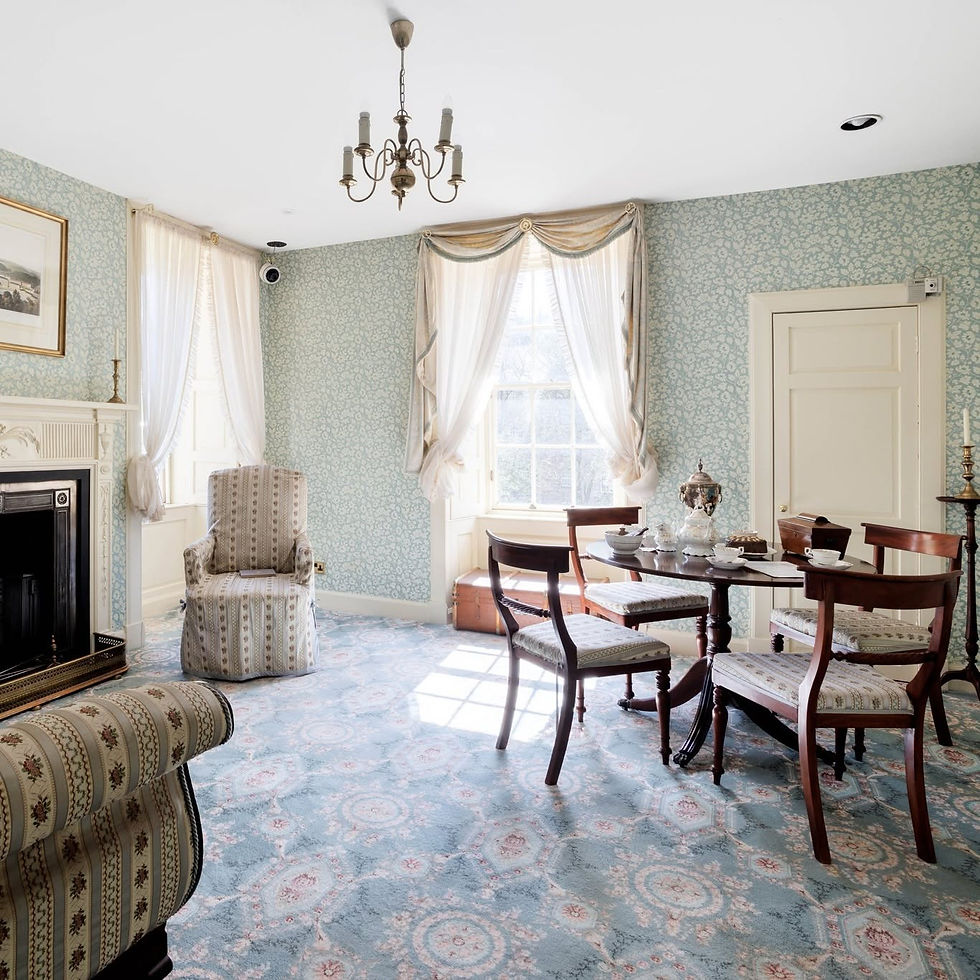
Apparently now there is a new immersive animated pod ride called Annie McLeod Experience that that travels back to 1820 to shows the life in the historic village.
Linns of Clyde

As the mills were hydro-powered, there are of course a series of waterfalls (Gaelic: linn) along the steeply descending river. They are called the Linns of Clyde. Three of these falls are just above the mill complex, and are easily reached by a short walk upstream. A hydroelectric power station nowadays abstracts much of the water. The site is also home to a number of fowls and birds. The most famous of these is Corra Linn which can be seen from one of the main walkways.
Travel Suggestions and Logistics
The place is remotely located, drive, although the town is also served by the national train at Lanark station. The guided tour fee is £5.50. The surroundings are all good hiking trails and waterfalls. Plan and spend a day there.
UNESCO Inscription

New Lanark is a small 18th- century village set in a sublime Scottish landscape where the philanthropist and Utopian idealist Robert Owen moulded a model industrial community in the early 19th century. The imposing cotton mill buildings, the spacious and well-designed workers' housing, and the dignified educational institute and school still testify to Owen's humanism.
References


Comments