


Bordeaux
已更新:4小时前
Classic port of the moon and wine - Routes of Santiago de Compostela in France 868; Bordeaux, Port of the Moon 1256; Gastronomic meal of the French 00437; Artisanal know-how and culture of baguette bread 01883

What and Why
I took my family to be part of the Paris Olympics (French: Jeux Olympiques), in ironically, Bordeaux in 2024 because: 1) Paris would ought to be exceedingly crowded and full of pickpockets; 2) I would like to explore other French cities; and 3) I understood that Bordeaux was classy, tourist-friendly and offered good food. Moreover it offers two other WHS nearby (Le Verdon-sur Mer and Saint-Émilion, as blogged plus itself) that I could tick off my bucket list and hence here we were. We were genuinely elated for this choice made and it turned out to become one of our best family holidays so far.
The cultural heritage of Bordeaux is defined by a dialogue between river, wine and stone. Known historically as 'The Sleeping Beauty (La Belle Endormie)' before its extensive urban renewal at the turn of the 21st century, Bordeaux houses one of Europe’s largest 18th-century architectural ensembles. It is inscribed as a WHS under the designation Bordeaux, Port of the Moon. This name honours the crescent-shaped Garonne river meandering around the city and wraps around the historical core like a bend. With the river, Bordeaux’s identity and history is bound to its geographical status as an inland port opening to the Atlantic Ocean and rest of Europe. The port is dominantly wine-based, the famous wine trade has made Bordeaux a global name. While Bordeaux’s wealth started and grew mainly through wine trade, it also involved colonial goods such as sugar, coffee, cocoa, cotton and indigo; but also unfortunately and incidentally transatlantic slave trade.

Toponymy
Against common beliefs, Bordeaux does not derive from 'bord d'eaux' meaning 'border of waters', referring to the river Garonne and Gironde estuary (estuaire de la Gironde). This is another folk etymology which is mere coincidental, probably good, but linguistically incorrect.
The name 'Bordeaux' actually comes from the ancient Gallo-Roman name Burdigala, which evolved through Old Occitan (Bordel) and Occitan (Bordèu) into Middle French (Bordeaulx) and then to nowadays Bordeaux. The stem 'burd-' means 'muddy or marsh' while '-gala' means 'bay' in Proto-Celtic. Hence Bordeaux simply means 'muddy bay'.
See
We stayed there for a week and we largely followed the official walking tour. I absolutely do not agree that this is a walking tour as there are simply so much to see in the city. We broke it up to three or four days, after all we have four very young children.
Place des Quinconces
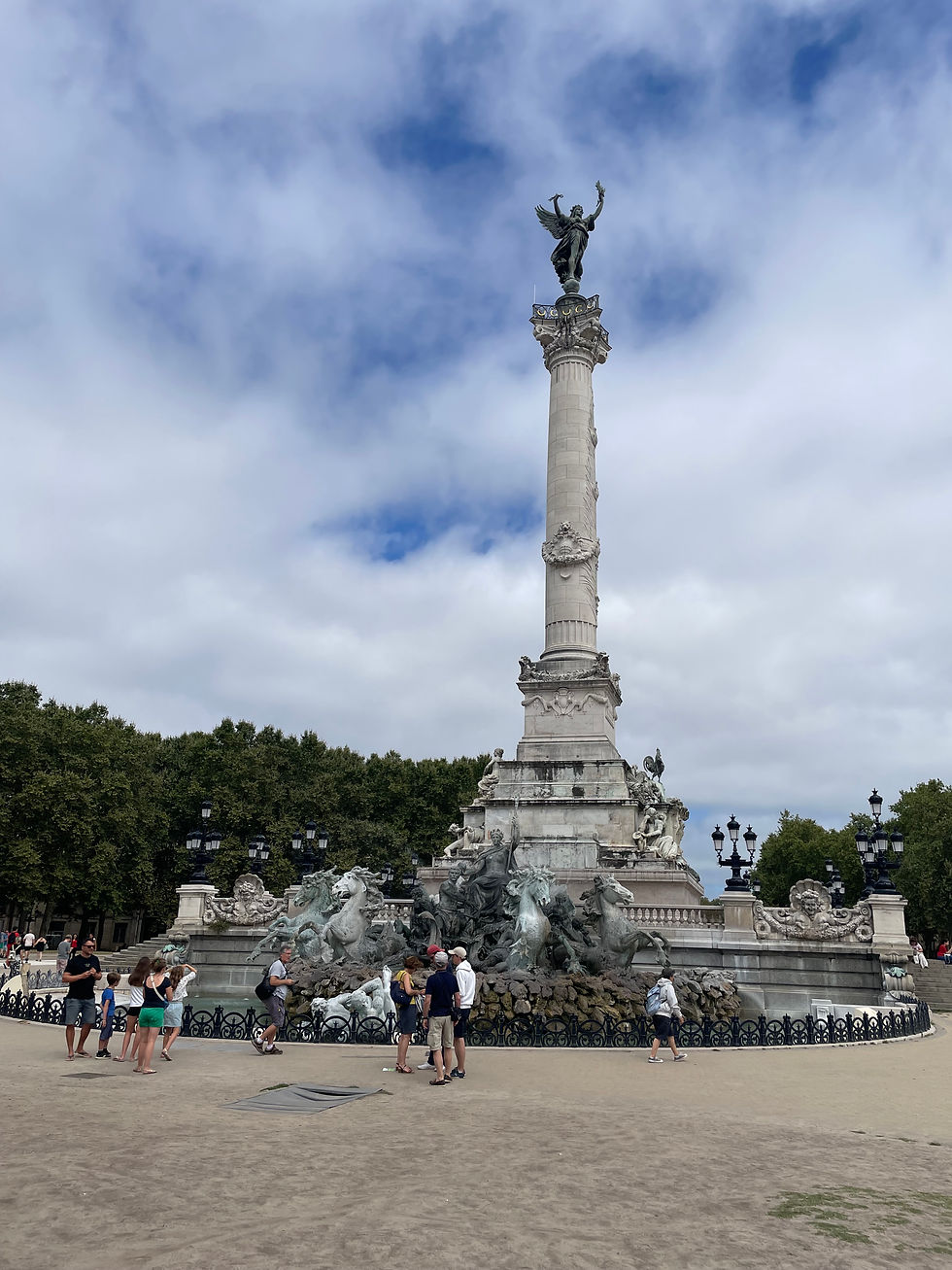
Place des Quinconces was our first landmark in Bordeaux and is undoubtedly the city’s defining central open spaces. Its name comes from the quincunx (quinconce) pattern in which trees were originally planted. The square actually occupies the site of the former Château Trompette, a fortified castle associated with royal control over the city. The transformation into a broad public esplanade signalled a change of ethos: from stronghold to openness.

The main monument of the space and actually the city is the flamboyant Monument aux Girondins, as pictured above. The monument, built during the late 19th century, serves as an artistic tribute to the Girondins who were executed during the French Revolution (Révolution française), as well as to the Republic. The Girondins were a prominent political group associated with the Gironde department, of which Bordeaux is the capital. The memorial is designed to reflect how the city chose to remember the Revolution via its special political identity. It features a tall column that rises above a base with a fountain, crowned by a bronze figure of Libertas.
At its base lie two monumental bronze fountains with allegorical sculpture: The Triumph of the Republic (Le Triomphe de la République) is located on the side facing the river, featuring a chariot pulled by horses symbolising power, energy and progress, driving away ignorance, vice and crime. The Triumph of the Concorde (Le Triomphe de la Concorde) is the other facing westward toward the city centre, symbolising peace and harmony while protecting commerce, agriculture and peace. During World War II, the sculptures were dismantled by German forces to be melted down for armaments.However, they were recovered undamaged in Angers after the liberation and reinstalled in 1983.
The plaza itself is used for public gatherings, fairs and events and one side of the square serves as the central tram interchange for the city.

Maison de Gobineau

A short walk from Quinconces brings visitors to Maison Gobineau, a distinctive triangular high-rise building at the edge of the historic centre. Its modern profile contrasts with the stone façades around it. The building is closely associated with the wine trade: it houses the Bordeaux Wine Council (Conseil Interprofessionnel du Vin de Bordeaux), the professional body representing the region’s wine sector.
Grand Theatre (Grand Théâtre)

Nearby stands the Grand Theatre (Grand Théâtre), one of Bordeaux’s most important neoclassical landmark where we spent almost half an afternoon (It is a fantastic air-conditioned shelter under the scorching sun). The building was designed as a public monument as well as a performance venue, including a theatre and various gallery halls; although in the beginning it was largely catering the wealthy. Its architecture reflects the ambition of highlighting Bordeaux as a major cultural hub of France, presenting an imposing façade of columns, a broad staircase and sculptural figures.
The theatre’s entrance is framed by twelve Corinthian columns, above which stand statues representing the Muses linking the building to ideals of art, beauty, knowledge and civic refinement. The building remains the home of the Opéra National de Bordeaux.

We originally planned to watch some shows in the theatre to pretend being classy and cultured. Unfortunately we forgot that French artists do not work during summer...
Outside the Grand Theatre is also another useful congregational area. The square outside is called Place de la Comédie, where lots of bustling cultural and commercial activities are going on. My son just spent his time on the French carousel.

Place de la Bourse

The crowning jewel of Bordeaux architecture must be the Place de la Bourse. Designed by Ange-Jacques Gabriel, who also designed the Place de la Concorde in Paris, the square was created to break down the mediaeval city walls and open Bordeaux to the Garonne.
The square is framed by two symmetrical structures facing each other across a central courtyard. The southern wing is known as the Hôtel des Fermes and was built to collect royal customs duties and taxes. Today it houses the Musée National des Douanes. The northern wing is the Hôtel de la Bourse and is the city's stock exchange and chamber of commerce.
The central pediments of the buildings feature sculptures celebrating international trade of the city. At the centre of the square, it used to stand a statue of King Louis XV (né Louis de Bourbon) on horseback. However it was melted down for cannon metal. It was replaced in mid-19th century by the Fountain of the Three Graces (Fontaine des Trois Grâces), representing the three daughters of Zeus (Greek: Ζεύς): Aglaea (Greek: Ἀγλαΐα, Aglaiê) symbolising beauty and elegance, Euphrosyne (Greek: Εὐφροσύνη, Euphrosúnē) symbolising joy and Thalia (Greek: Θάλεια, Tháleia) symbolising abundance.
We spent a good time in the northern wing as it was temporarily converted to a tourism office celebrating the Olympic Games, while we took some shelter from the heat wave.
The Place de la Bourse faces directly the Garonne waterfront, as below.

Water Mirror (Miroir d'Eau)
The highlight of our first day of visit is definitely the Water Mirror (Miroir d'Eau) just in front of the Place de la Bourse. Just ask my son, he immediately went totally naked and started jumping around and humming his Peppa Pig songs along the way. The simple pool, created in 2006 as part of the waterfront redevelopment, is the world's largest reflecting pool, covering 3,450 m² of black granite slabs. It actually alternates between having a shallow skin-layer of water and creating a mirror effect with the intention to reflect the 18th-century facades of the Place de la Bourse, and then after draining the water, it goes to a misting process of fogging the entire pool, creating another mystical translucent atmosphere. During the shallow water phase, it reflects the Place de la Bourse almost perfectly; when the mist rises, the familiar façades become partly veiled and produces a rainbow.

My son went totally nuts in the pool, and so did most children. By the way the main picture above was genuinely taken by me with an Iphone: it was not that difficult really, of course I did receive some tips from a professional beforehand. Just go to the pool very early when traffic is low, wait for a good sunny time and snap. The black slabs will do most of the job!
Parliament Place (Place du Parlement)
From the Place de la Bourse, we walked to the Parliament Place (Place du Parlement), expecting to see the local government parliament. We found nothing but just another small Rococo-styled square. Originally called Place du Marché Royal, the square is framed by uniform three-storey limestone buildings featuring arched arcades on the ground floor, wrought-iron balconies, and mascarons. It is now another tourist square filled with restaurants, bistros and shops.

Porte Cailhau
The next two days we explored the more working-class and religious districts of Bordeaux, contrasting the more bourgeois, classy and upper class landmarks on the first day; and I have to say it was just as eye-opening.
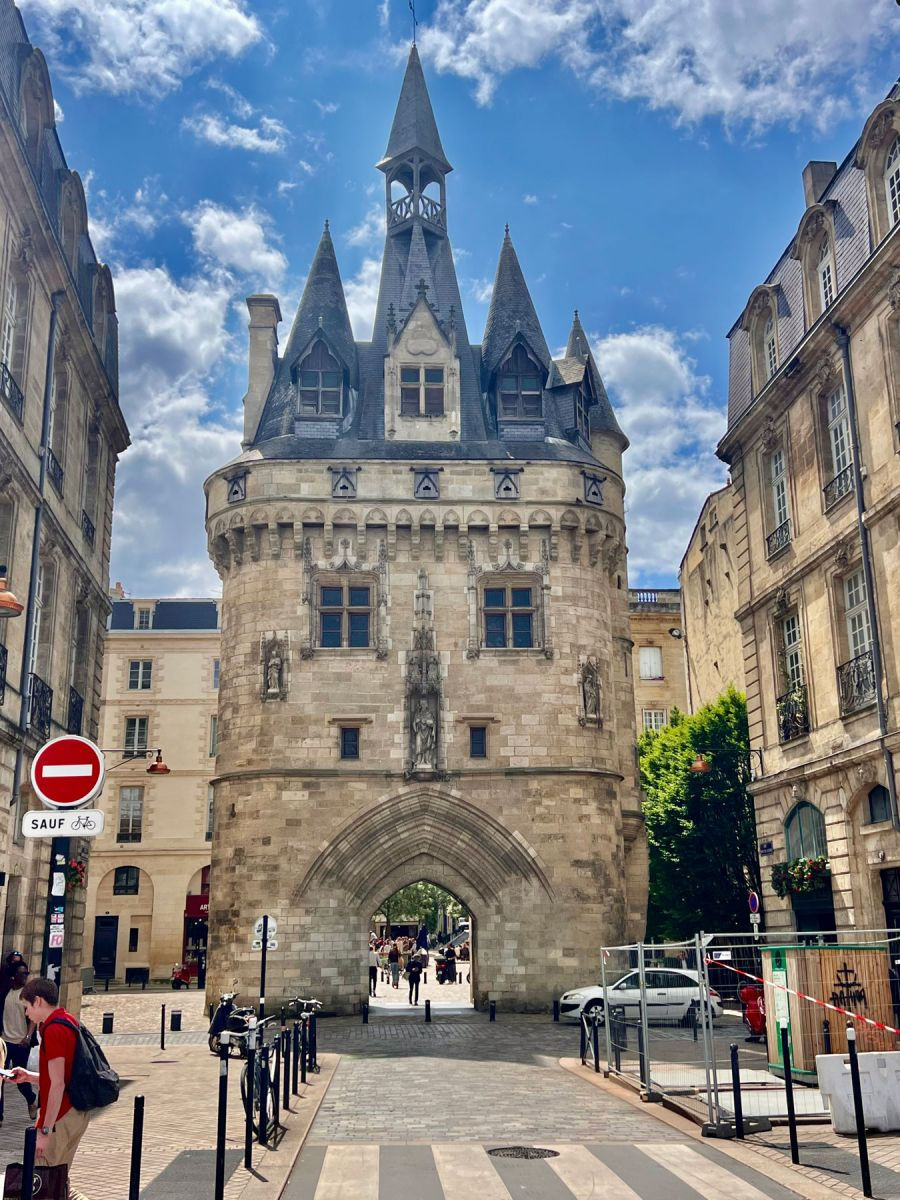
Standing at the intersection of the old town and the Garonne quay, the Porte Cailhau was built during the late 15th century as an extension into existing ramparts. Erected to commemorate King Charles VIII's (né Charles Valois) victory over the Italian League at the Battle of Fornovo (Italian: Battaglia di Fornovo), the gate combines defensive military architectures with various decorative Renaissance elements. At 35 m, it functioned both as a defensive tower guarding the riverbank and an entry portal into the city.
The gate’s name, meaning 'pebble' in Gascon dialect, and history are associated with the old palace district and the city’s mediaeval political life. The area around the gate has changed greatly: the old port has long given way to quays designed for promenades and public events. Yet the Porte Cailhau still marks a historic line reminding visitors where the riverfront once was and the city's main exchange of people and vessels.
Porte du Bourgogne

At the eastern edge of the historic centre stands Porte de Bourgogne, an 18th-century triumphal arch at the meeting point of major routes. Designed by Gabriel again, it was conceived as a monumental entrance to the city via the old road network, facing the approach from the east and the bridge crossing the Garonne. It features a classical, unornamented Doric profile designed to frame the perspective looking east across the river toward the district of La Bastide. The portal, located at Place Bir-Hakeim, enters into the working-class area of the city, which is honestly a bit messy, contrasting the nearby upscale area of the waterfront and Place de la Bourse.
The gate is named in honour of Louis, Dauphin of France, Duke of Burgundy (Louis, Duc de Bourgogne, né Louis de Bourbon), the grandson of King Louis XV.
Saint Michael's Basilica (Basilique Saint-Michel)

The Saint Michael's Basilica (Basilique Saint-Michel) dominates the surrounding district near Place Bir-Hakeim with its massive belfry, rising above the dense neighbourhood of markets, shops, cafés and residential streets. The church was built over several centuries, and is one of Bordeaux’s largest religious buildings. The belfry, called the Flèche Saint-Michel, stands separate from the basilica itself, and is the second-tallest Gothic (German: Gotik) spire in France
The basilica is a major stop on the French pilgrimage route to Santiago de Compostela (Routes de St-Jacques de Compostelle en France), or Camino, as blogged in Santiago de Compostela. Constructed between the 14th to 16th centuries, the basilica is an exceptional example of Flamboyant architecture. The huge church interior contains 17 side chapels and a small but beautiful carved stone pulpit depicting Saint Michael (Hebrew: מיכאל, Mîkhâ'êl) slaying a dragon.

Bordeaux Cathedral (Cathédrale Saint-André)

After getting through some of the narrow streets near the Saint Michael's Basilica, we reach with intention the other stop of the Camino route. The Bordeaux Cathedral (Cathédrale Saint-André) is a major Gothic church with a long history as a religious and civic centre. Its architecture developed over several centuries, and hence the building bears the marks of changing styles and construction phases.

According to the signboards, one of the most significant events associated with the cathedral was the marriage of Eleanor (Aliénor, née Alienòr Ramnulfids) of Aquitaine and Louis VII (né Louis Capet) in 1137. The union effectively linked Aquitaine to France, although the political relationship between the region and the monarchy would change repeatedly. Bordeaux’s history shifts incessantly between France and England, particularly during the long period when Aquitaine was under English rule. The cathedral thus stands not only as a religious building but as a witness to the city’s changing political geography.
Like Saint Michael's Basilica, the cathedral has a separate belfry away from the cathedral called the Tour Pey-Berland. Its separation from the cathedral is often explained by the instability of the ground and the desire to protect the church structure from the vibration of bells.
From there we had a quick early dinner outside the cathedral and we headed to our Olympic football match, to be discussed later.
Place Fernand-Lafargue
Located a short walk between the two cathedrals, the Place Fernand-Lafargue has served as the commercial centre of mediaeval Bordeaux, until now. Beyond its role as a market for fish, meat, and local produce, the square hosted public judicial punishments, including the pillory. The pillory is long gone and the area is now one of the main commercial and food streets of the city, where we had a few of our meals. It is surrounded by fairly narrow streets and is a meeting place for café culture and local nightlife. I met my friends from University of Bordeaux (Université de Bordeaux) and that was where they suggested to meet for lunch.

Big Bell (Grosse Cloche)
The Big Bell (Grosse Cloche) is one of the most recognisable remnants of mediaeval Bordeaux. The gate and bell tower are part of the former city wall and city hall building and hence a passage through the defensive enclosure. The present structure incorporates the historic gateway and a large bell, which was traditionally rung at the following dates at 11 am: 1st January (new year day), 1st May (Labour Day), 8th May (Victory in Europe Day), 14th July (National Day), 28th August (Liberation of Bordeaux during World War II), 11th November (Armistice of World War I) and on the first Sunday of every month. At times it also rings to mark public celebrations or very important civic events, like the start of the grape harvest (vendanges).

Cast in 1775, the bell, nicknamed Armande-Louise, weighs nearly 7,800 kg. The name reminds me of the Big Ben, as blogged in London | West.
Rohan Palace (Palais Rohan)

The religious visit ended with Rohan Palace (Palais Rohan), now Bordeaux’s city hall (hôtel de ville). It stands majestically across from the Bordeaux Cathedral. Built in the 18th century as the residence of archbishop Ferdinand-Mériadec de Rohan, it reflects the wealth and influence of the church in Bordeaux.
Contemporary Art Museum (Musée d'Art Contemporain)
After two or three days of historic heritage visits, we spent the last two days in Bordeaux visiting a few more modern and techie landmarks. The first one that we visited was the Contemporary Art Museum (Musée d'Art Contemporain). The gallery is quite big and there are many sections to visit. However not a really artsy person, my wife and I just walked around to take advantage of the air-conditioning. I also managed to somehow get a ticket discount for everyone because I spoke French!

Base Sous-marine

The Base Sous-marine belongs to a radically different chapter of Bordeaux’s history. Built by German occupying forces during World War II, it was the submarine base to support military operations in the Atlantic. The building’s scale is overwhelming: it is a vast concrete structure with thick protective walls, multiple submarine pens and a roof designed to resist aerial attack. Because demolition was deemed so economically impractical due to the massive volume of reinforced concrete, for many years after the war it just stood as an imposing remnant of the war, making it difficult to integrate into the city’s public identity, either politically and economically.
One fine day an idea came and it was turned overnight to a very popular cultural gallery. Today part of the structure houses Bassins des Lumières, an immersive digital art centre. Projected images and sound fill the large chambers and water basins, using the architecture’s scale to create an unusual exhibition environment. It becomes a very modern and enjoyable site, even to my two young children. We navigated the maze inside and watched a show about space and different images and animations of space-related themes were projected on every walls to create a hyper-dimensional perspective. Definitely worth a visit.
Wine and Wine Trade Museum (Musée du Vin et du Négoce)

There are actually two of them depending on your 'taste': one is the more old-schooled Wine and Wine Trade Museum (Musée du Vin et du Négoce) and the ultra-modern Cité du Vin, which is slightly outside the historic centre. We went to the more old-fashioned one as it was simpler closer to the city centre. My sister actually went to both as she works in the hospitality industry, and she also preferred the former.
After comparing notes, we believed that we made the right choice as we were more looking for an authentic (still slightly artificial), rustic, historical cellars. I was personally anticipating a deeper dive specifically into Bordeaux trade history and we were properly rewarded. To me, it was easily the best way to get an idea about the wine heritage of the city. It was also way more affordable. The Cité du Vin, built like a decanter, is for more quick-glimpse, techie or posh visitors.
Experience, Buy and Do
Dune du Pilat

We drove from Bordeaux for approximately an hour to the nearby coastal town of Arcachon, where the Dune du Pilat is located. Dune du Pilat is the tallest sand dune in Europe, rising more than 100 m meters above sea level and stretching along the Atlantic coast at the bay entrance in southwestern France. Formed by millions of cubic metres of fine sand driven by ocean winds and tides over thousands of years, the monumental geological formation acts as a natural barrier between the Atlantic Ocean and the Landes forest (Landes de Gascogne).
Walking around and up the dune was painstakingly strenuous as our feet got submerged into the sand every step on the way. However reaching the summit via staircase or climbing the sandy slopes rewards us with an expansive 360° vistas overlooking the Atlantic Ocean and the forests behind us. Stunning view.
As you can see from the picture above, the easiest way to get down from the dune summit is sliding, where my nephew and my son seemed to have enjoyed a lot. Pure enjoyment for them, but not for me, as I had to clean my son from all sand grains after the slide; otherwise they would be all over the place we stayed.
Before gong to the dune, we went for a weekend flea market just outside the Place Bir-Hakeim.

As mentioned, we came to Bordeaux to watch the Olympic Games in purpose. We watched a football match in the newly renovated Stade Atlantique Bordeaux Métropole so that my family could feel the Olympic spirit and atmosphere. The results mattered little to my family and my troops but all of them did enjoy it!
Eat and Drink
Bordeaux wine (Vin de Bordeaux)
Let us be honest, Bordeaux is all about its wine! The cultural identity of Bordeaux is inextricably tied to its wine production. The Bordeaux wine region encompasses over more than 1,000 km² of vineyards, producing predominantly red wines along with dry whites, and sparkling wines. As blogged in Le Verdon-sur Mer, we spent a good afternoon exploring many of the renowned châteaux of the region, and my wife who is still a certified sommelière, was able to explain to me, a non-drinker, everything about it. So this section is pretty much her input, and you can imagine she was pretty proud about it.

The viticultural landscape of Bordeaux is geographically bisected by the Garonne and Dordogne rivers, which converge to form the Gironde Estuary. This hydrological network splits the region into three distinct zones:
The left bank (Rive gauche: Médoc and Graves): Situated west of the Garonne and Gironde. The well-drained gravel soils retain heat, making them ideal for ripening late-ripening varieties, principally Cabernet Sauvignon. Almost all the main châteaux we visited mull this grape specie.
The right bank (Rive droite: Libournais): Situated east of the Dordogne, encompassing the blogged Saint-Émilion, Pomerol, and Fronsac. The soil profiles feature cooler, moisture-retentive clay and limestone mixtures. These soils favour early-ripening varieties, principally Merlot and Cabernet Franc.
Entre-Deux-Mers: The rolling hills situated between the Garonne and Dordogne rivers, dominated by clay-limestone soils utilised for dry white wines like Sauvignon Blanc, Sémillon and other accessible reds.
The above grape varieties are the major ones found in the three regions around Bordeaux.
Historically, the port helped Bordeaux wines become internationally known. Trade with the British Empire became especially important after Eleanor of Aquitaine, mentioned above, became Queen of England when she remarried with Henry Plantagenet, later Henry II, in the 12th century. English demand helped establish and start enduring international commercial links.
As time goes by, Bordeaux wine became internationally famous and a standard was needed to adjudge the quality and value of the produce. In came Napoloen III (né Charles Bonaparte) when he ordered the establishment of the Classification 1855, produced for the Exposition Universelle in Paris, which effectively became the gold standard of most Bordeaux wines. It continues to shape perceptions of prestige, although it covers only part of the region and does not even represent the full diversity of Bordeaux. There are other appellations and classification systems, like the blogged Saint-Émilion having their own histories and standards. The classification is best understood as one of reputational instrument in the commercial history of wine, rather than an actual measure of wine quality.
The list ranked 61 red wines of the region into five tiers of First Growths (Premier Grand Crus Classé) to Fifth Growths (Cinquièmes Crus Classé). In particular the First Growths come only from the five prestigious estates of Château Lafite Rothschild, Château Latour, Château Margaux, Château Haut-Brion and Château Mouton Rothschild, all of those we had visited except Château Haut-Brion in Pauillac without realising beforehand! A similar ranking exists parallel for the white wines.
Bordeaux wine is not only about its quality but its wine trade is equally culturally significant. The trade has relied on a distinctive network of growers, négociants and courtiers. Growers cultivate grapes and make wine. Négociants buy and sell wine, and may also blend, bottle or market it. Courtiers or brokers, connect producers and merchants and facilitate transactions. These block-chained roles have changed over time, but their interaction remains part of the region’s wine special identity.
Hence the experience in Bordeaux should not only be appreciated via tasting, but a deeper understanding comes from asking how the wine was made, who made it, what the label means and what the surrounding landscape contributes. Tasting should definitely not merely a test of expensive bottles, and the French do make an occasional mockery of the many questionable investments and purchases of the vineyards of the region.
Steak and fries (Steak-frites)

The entrecôte is a classic bistro preparation consisting of a ribeye steak cooked over dried grapevine cuttings (sarments), which produce intense heat and a subtle smoky aroma. The steak is served with the restaurant signature Bordelaise sauce, red wine, shallow-fried shallots, butter, herbs, black pepper, and poached beef bone marrow (moelle).
This plate is served in one institution called L'Entrecôte and this restaurant is built around a strict, single-dish concept that has remained virtually unchanged since the brand's founding in 1959. What makes this Bordeaux restaurant and its specific dining ritual distinctive comes down to a few key perhaps quirky elements. For one there is no choice, except for dessert. When we sat down, the server asked only two questions about how would the steak be cooked and what to drink. Every diner receives the exact same fixed meal. The main course of steak is standard 170 g of trimmed, thinly sliced sirloin (faux-filet, despite the name entrecôte) served with French fries. No size difference.
The service is also universally served in two stages: To prevent the thin slices of steak from going cold while you eat, the kitchen divides your portion into two servings. The server places the first half of the meat and a pile of fries on your plate, while the remaining steak stays warm on a heated silver platter at your table. Once you finish the first round, the server returns to plate the second half along with a fresh batch of unlimited fries.
The restaurant also operates strictly on a walk-in basis and no one is exempted from the excessively long waiting line, unless one chooses to eat during an unusual hour.
The restaurant is part of the original French family-run chain by the descendants of Henri Gineste de Saurs. All of its restaurants features unmistakable trademark yellow-and-black striped awnings, bright yellow paper tablecloths, and waitresses dressed in yellow blouses with black aprons.
Above is our picture in queue.
Oyster (Huître)

Arcachon is famous for its oysters, given its proximity to the coast. Oysters from Arcachon are served raw on the half-shell over ice, accompanied by fresh lemon, red wine vinegar with minced shallots, salted butter and hot crépinettes, small pork sausages wrapped in caul fat. This oyster serving is a cornerstone of the regional culinary tradition. We had our oysters in Chez Jean-Mi.
Stay
We stayed for the first time with another family and my sister in an Airbnb house called Le Bouscat. Easily one of the best Airbnb I have ever stayed in: the house was beautifully decorated; the host was very hospitable and responded promptly when requested; and the place was right in front of the tramline along one of the main roads. During the few days of heat waves, our family was just happy to stay inside the house. Just check the website yourself. Highly recommended.
Travel Suggestions and Logistics
Bordeaux is served by its own international airport and the city itself is fully connected by its own trams. Almost every landmarks described are accessible by foot or tram. We stayed in Bordeaux for a full week with excursions to Le Verdon-sur Mer, Saint-Émilion and various vineyards.
UNESCO Inscriptions
Santiago de Compostela was the supreme goal for countless thousands of pious pilgrims who converged there from all over Europe throughout the Middle Ages. To reach Spain pilgrims had to pass through France, and the group of important historical monuments included in this inscription marks out the four routes by which they did so.
The Port of the Moon, port city of Bordeaux in south-west France, is inscribed as an inhabited historic city, an outstanding urban and architectural ensemble, created in the age of the Enlightenment, whose values continued up to the first half of the 20th century, with more protected buildings than any other French city except Paris. It is also recognized for its historic role as a place of exchange of cultural values over more than 2,000 years, particularly since the 12th century due to commercial links with Britain and the Low Lands. Urban plans and architectural ensembles of the early 18th century onwards place the city as an outstanding example of innovative classical and neoclassical trends and give it an exceptional urban and architectural unity and coherence. Its urban form represents the success of philosophers who wanted to make towns into melting pots of humanism, universality and culture.
The gastronomic meal of the French is a customary social practice for celebrating important moments in the lives of individuals and groups, such as births, weddings, birthdays, anniversaries, achievements and reunions. It is a festive meal bringing people together for an occasion to enjoy the art of good eating and drinking. The gastronomic meal emphasizes togetherness, the pleasure of taste, and the balance between human beings and the products of nature. Important elements include the careful selection of dishes from a constantly growing repertoire of recipes; the purchase of good, preferably local products whose flavours go well together; the pairing of food with wine; the setting of a beautiful table; and specific actions during consumption, such as smelling and tasting items at the table. The gastronomic meal should respect a fixed structure, commencing with an apéritif (drinks before the meal) and ending with liqueurs, containing in between at least four successive courses, namely a starter, fish and/or meat with vegetables, cheese and dessert. Individuals called gastronomes who possess deep knowledge of the tradition and preserve its memory watch over the living practice of the rites, thus contributing to their oral and/or written transmission, in particular to younger generations. The gastronomic meal draws circles of family and friends closer together and, more generally, strengthens social ties.
The baguette is the most popular kind of bread enjoyed and consumed in France throughout the year. The traditional production process entails weighing and mixing the ingredients, kneading, fermentation, dividing, relaxing, manually shaping, second fermentation, marking the dough with shallow cuts (the baker’s signature) and baking. Unlike other loaves, the baguette is made with only four ingredients (flour, water, salt and leaven and/or yeast) from which each baker obtains a unique product. Baguettes require specific knowledge and techniques: they are baked throughout the day in small batches and the outcomes vary according to the temperature and humidity. They also generate modes of consumption and social practices that differentiate them from other types of bread, such as daily visits to bakeries to purchase the loaves and specific display racks to match their long shape. Their crisp crust and chewy texture result in a specific sensory experience. The baguette is consumed in many contexts, including during family meals, in restaurants, and in work and school cafeterias. The production process is primarily transmitted through work-based training, combining school courses with work experience in a bakery. This apprenticeship enables future bakers to acquire the necessary knowledge of the ingredients, tools and process.
References
Gastronomic meal of the French | UNESCO Intangible Cultural Heritage
Comments
Please share your thoughts and comments about the blog. If you need suggestions to build a travel itinerary, please let me know. More than willing to help. I would also like to build a bespoke-in-depth travel community around UNESCO WHS and ICH.


留言