


Hamburg
Updated: Sep 2
A very cold port city that may or may not serve hamburgers - Speicherstadt and Kontorhaus District with Chilehaus 1467

What and Why
The Old Town (German: Altstadt) of Hamburg is really defined by its intimate, centuries-long relationship with water, maritime commerce, and civic autonomy. After all, this city was one of the main centres of the Hanseatic League (Hanse), the network of mediaeval commercial and defensive network of merchant guilds and market towns of Northern Europe. Although the modern city extends far beyond its historic centre, the Old Town preserves an unusually concentrated collection of buildings, streets, churches, civic institutions and commercial districts that together narrates Hamburg's story transformahation from a mediaeval trading settlement into a major European port where we disembarked from our cruise ship. The district overall architecture and urban morphology hence expresses successive phases of Hamburg's economic, political and social development, which makes it an extremely touristy town. In spite of all these historic significance, the first question I asked my wife when I reached the city was: 'Are there hamburgers in Hamburg?' and I got a bad sneer from her on this naive bad joke...
The highlight of the city, from this UNESCO blog perspective, was internationally reinforced in 2015, when the Speicherstadt and Kontorhausviertel were inscribed onto the UNESCO WHS list. The two neighbouring districts are considered outstanding examples of the relationship between port-related warehouses and modern office buildings associated with international trade. It recognises the way, as aforementioned, in which the built environment demonstrates the economic and technological transformation of a major port city during the late 19th to 20th centuries.

Toponymy
The name Hamburg originates from Hammaburg, a 9th-century castle built in the year 808 by order of Emperor Charlemagne (né Charles Martel (French)). The root combines the Old High German element 'burg', meaning 'fort' and not 'hill'; while 'hamma' refers to a piece of land around a river bend entering into a marsh.
See
Before I came to Hamburg, all my colleagues told me that the city would be cold, and no joke it really was! In fact my Scottish friends even said it was the coldest cities they had ever been to! Clearly we went in Spring and probably it was not the coldest cities I had been to, but still it was really cold!
Speicherstadt

Upon disembarkation from the ship at HafenCity, the port district, the first major landmark right in front of us was the Speicherstadt, literally meaning 'warehouse city'. The complex was gradually built in multiple phases during the late 19th to early 20th century when Hamburg joined the German Customs Union (Zollverein) in 1888. Hamburg negotiated itself to retain a duty-free zone, continuing its legacy from the Hanseatic League. The Speicherstadt was built as a dedicated free-port warehouse complex where goods could be stored, processed, and re-exported without paying customs duties. For over a century, these buildings stored high-value imported commodities, including coffee, tea, cocoa, spices, and tobacco.
Just from my naked eyes, the building looks just like a massive red-brick boring warehouse connected by canals and barges. Looking at it especially from the inside will tell a far more sophisticated story and a slap on my face. The historic Gothic Revival complex consists of large warehouse blocks, ancillary structures, canals, bridges and streets. It is easily one of the largest coherent historic ensembles of port warehoushaes in the world. The warehouse district was originally developed on a group of narrow islands and extends for approximately 1 km, and it was subsequently reconstructed and further extended during World War II.

The architecture of the Speicherstadt is particularly striking because of the combination of historic appearance and modern industrial functions. The buildings were primarily constructed from red brick, using neo-Gothic and neo-Romanesque forms. Yet these were fundamentally utilitarian buildings designed to accommodate enormous quantities of goods and facilitate efficient commercial operations. Tall façades, pointed arches, decorative brickwork, vertical windows and elaborate gables create an almost monumental, imposing, and on my first sight communist feel. This imposing feel was further accentuated by the cold weather when we were there.

This contrast between appearance and function is actually central to the district's heritage value. The Speicherstadt may appear mediaeval or Gothic (Gotik) to a casual visitor, but it was in fact a highly modern industrial complex for its period. The buildings incorporated contemporary technical systems, including electricity and all sorts of hydraulic lifting equipment. The combination of advanced technology with historical architectural design illustrates the characteristic eclecticism of late 19th-century industrial architecture.
The water canals and waterways are thoroughly amalgamated and integated into its logistical system, both functionally and aesthetically. Goods could be transported by boat close to the warehouses, while streets and bridges provided connections on land, while it forms a distinctive urban landscape with a mediaeval vibe.

Of course, the current Speicherstadt is no longer associated with warehousing but has been transformed into a large cultural complex. The district is now associated with galleries, museums, restaurants, shops and various cultural and touristic attractions. The former industrial environment has become one of the most visually distinctive parts of Hamburg's tourist landscape. Moreover the contrast between red-brick warehouses, canals and modern buildings in neighbouring HafenCity is particularly important to its appeal.
Amongst the many attractions within the Speicherstadt, including Hamburg Art Gallery (Hamburger Kunsthalle) and Deichtorhallen, I would recommend visiting the Miniatur Wunderland Hamburg. The attraction holds a a Guinness World Record, it contains the largest model railway system in the world with a total track length of more than 16 km!

Chilehaus

Directly north of the Speicherstadt lies the Kontorhausviertel, literally meaning the 'Office District' in German, Europe’s first dedicated office building district, constructed during the early 20th century. The area emerged particularly strongly during the 1920s and 1930s, when large office buildings were constructed to accommodate businesses associated with Hamburg's port and international trade. The urban planning and architecture were radically different from the warehouse district, yet the two areas were economically symbiotically interdependent.
Once my family walked towards the district, we immediately noticed the more modernist block form when compared with the warehouse area. The Kontorhausviertel is characterised by massive blocks, dark red façades, squarish geometric forms. On the various display we were told that its architecture is associated with Brick Expressionism (Backsteinexpressionismus) and the New Objectivity (Neue Sachlichkeit) movements during the era. These buildings demonstrate how Hamburg's architectural identity evolved from the 19th-century historicism of the Speicherstadt towards the more modern architectural language of the inter-war period.
Of the utmost significance is the Chilehaus, as above. The building was commissioned in 1920s by the shipping magnate Henry Sloman, who made his fortune trading saltpetre from Chile, and hence the peculiar name. The dark-brown building features an iconic, sharp point resembling a ship's bow, creating a powerful and important visual connexion with Hamburg's maritime identity. The display also mentions that the brick facades change tone with sunlight, but since we came during a snowy winter, we could not see any, nor could we bear the cold to observe anything.

The building is still in use.
City Hall (Rathaus)

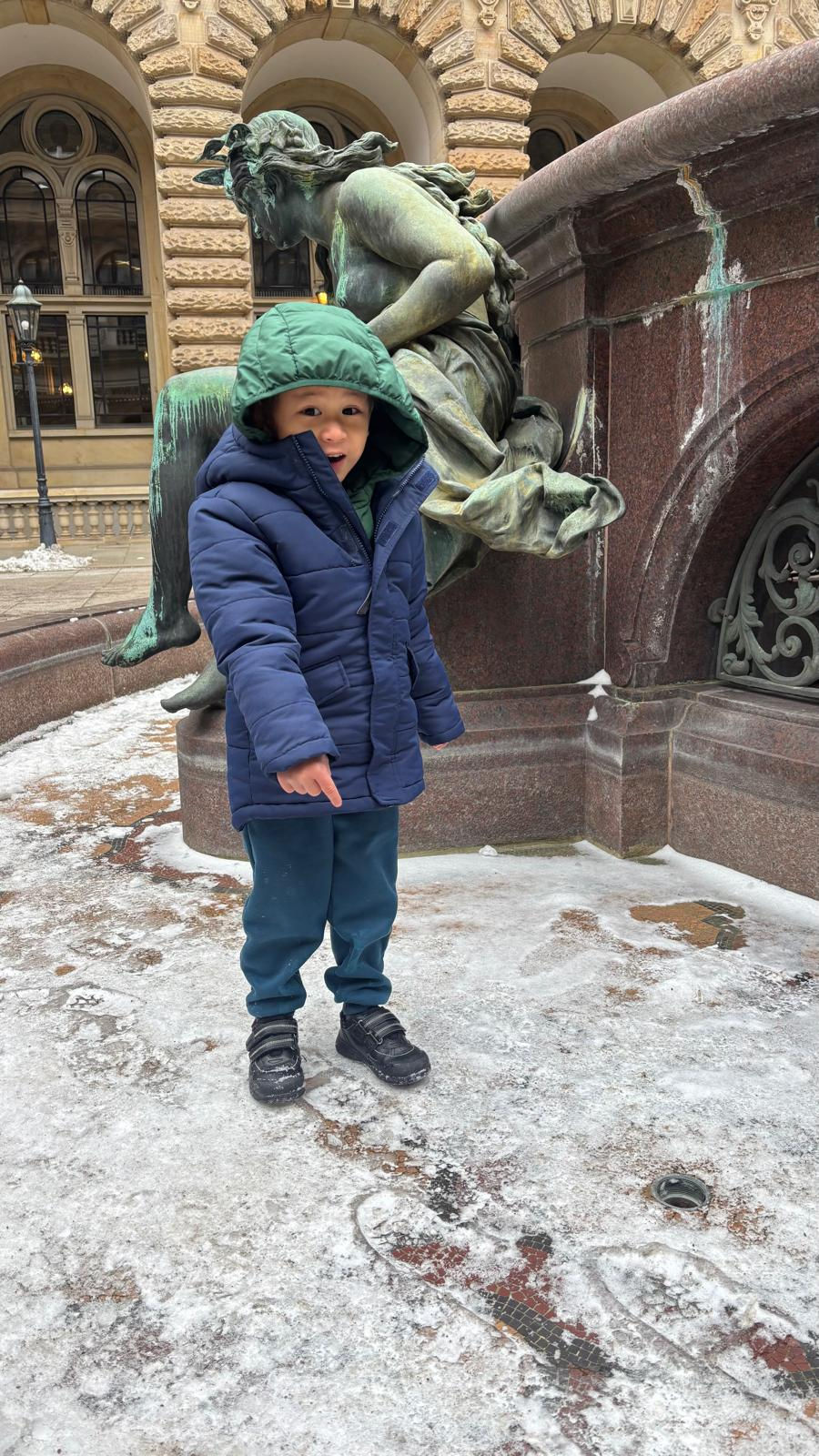
A few minutes walk from Speicherstadt is Hamburg City Hall (Rathaus), where we were shivering with cold while my children were simply slumbering throughout as pictured above. Whereas the two previous monuments primarily express Hamburg's commercial and industrial history, the City Hall obviously represents political authority, civic identity and the self-image of the city.

After writing so many blogs and with little initial knowledge of architectural style, I could now immediately and cheekily tell my wife that the building was constructed in a Neo-Renaissance style, with an imposing façade, elaborate ornamentation and a monumental tower, expressing as much grandeur as possible. There was a reason for the building's expressiveness. Apparently due to Hamburg's traditions as a Hanseatic city, merchants and businessmen exercised considerable influence over civic government. The City Hall therefore needed to represent Hamburg not simply as an administrative unit but as a wealthy, self-confident city with a distinctive political identity and institutional authority, intentionally to trump over commercial influence.
The Rathausmarkt in front of the building is equally important. The square has served as a major congregation spot for Hamburgers and tourists alike ever since. As a matter of fact, Hamburg's official walking route, for example, begins at the square before continuing towards all the monuments.
During our visit, we were greeted with a small local Armenian group who were honing their national costumes and dances, apparently filming it for social media. Quite a treat, and heads off for doing it while braving the cold!
My family had more fun enjoying the snow and the cold outside the City Hall, which is actually the Hamburg Chamber of Commerce (Handelskammer Hamburg), as below.
Saint Nicholas Church (Hauptkirche Sankt Nikolai)

Saint Nicholas Church (Hauptkirche Sankt Nikolai) is no longer a church, it is rather a piece of scarred history of Hamburg. At one time during the 1870s it was actually the tallest building in the world, the church was largely destroyed during the Allied bombing of Hamburg in July 1943.
After the war, rather than rebuilding the church, the city purposefully preserved the charred stone spire, outer walls, and crypt as a memorial to the victims of World War II and totalitarianism. In particular, the underground crypt houses an exhibition detailing the destruction of Hamburg during the raid. There is also a glass elevator that carries visitors up the top of the spire for panoramic views across the city and the harbour.
By intention and my personal introspection, the church ruin reminds us that cultural heritage is not necessarily synonymous with beauty, pride or nostalgia. Heritage can also involve trauma, destruction and moral reflection.
Elbphilharmonie

Depends on how you interpret, the Elbphilharmonie might resemble a sail, a wave or an iceberg (my children said it looked like a big cake). The shiny iconic building sits right at HafenCity and is the main concert hall of Hamburg. The building is the latest addition to Hamburg's harbour front and was inaugurated in 2017.
German Custom Museum (Deutsches Zollmuseum)

The German Customs Museum (Deutsches Zollmuseum), is located right next to the Speicherstadt and presents the history of the customs all the way from the ancient times to German Customs nowadays. In particular interest to was the custom operations and transition from German Reich (Deutsches Reich) to East Germany (Deutsche Demokratische Republik) / West Germany (Bundesrepublik Deutschland) to reunification.
The historical building was built in the late 19th century as a customs office. The historic exhibits and the illustrations of customs work explain the importance and development of the customs administration, demonstrating the role, organisation and objectives of customs from the Roman times until today. Extremely informative and I would recommend a visit, but almost all exhibits are in German only.
This should be noted that this is a government official building and taking a lift requires an official to switch on the lift and accompany you along. That was the inconvenient part when we brought our children with our stroller and a toilet trip did involve quite a bit of effort and logistics.
Experience, Buy and Do
Westfield Hamburg Überseequartier
Disembarking at Hamburg is really convenient when the cruise terminal is attached with Westfield Hamburg Überseequartier. It also offers a good variety of restaurants to suit a different palate than the cruise buffets.

Eat and Drink
Hamburger
Back to my first question: 'Are there hamburgers in Hamburg?'. Of course there are, plenty in fact. However do hamburgers originate from Hamburg? Definitely not, but the connexion is closer than most people think.
There is an actual connexion between Hamburg and the hamburger. The story really is about the Hamburg being the main port for transatlantic shipping routes for German emigrants or merchants going to America, in-so-doing perpetuate the Hamburg steak to the new land and then slowly transformed it to the American hamburger as we know it.
The word hamburger originally means 'from Hamburg' in German, just like Frankfurter or Wiener (do notice the joke regarding these two sausages in our blogged Vienna (Wien) | East). Hence linguistically hamburger has absolutely nothing to do with ham, and it is both absurd and silly that some countries change the term 'hamburger' to 'beefburger' to avoid association with ham or pork.
A Hamburg steak is effectively mined beef formed into a steak-like patty, known as Frikadelle in German, although there are variation of it that may or man not differ from our known hamburger patty.
Hamburg genuinely becomes relevant in the story during the 19th century when Hamburg was Europe's main gateway for trade and migration. As they left then Germany, they brought into American the Hamburg steak, and a 'Hamburg-styled' steak became a good useful label. However notice that I still use the word 'steak' instead of 'sandwich', as it was largely served as a dish. It was not until late 19th century then the patty was sandwiched by Americans and transformed it into in one of its greatest exports. It also appeared at the perfect timing, by luck or by intent. America during the time was experiencing massive industrialisation, mass immigration, increase in pace, availability of cheap meat, but most importantly the development of mechanical food processing machineries. All these made the Hamburg steak very convenient as it was inexpensive, easy to produce, quick to cook and eat but perhaps inadvertently the requirement of not very high quality meat.
Hence when I joked about finding a hamburger in Hamburg, the joke would be on my own stupidity. We did however find our little hamburger in Westfield to make for the joke.

Rundstück

Another peculiarity of Hamburg is the shape of the bread roll. Against the mainstream German bread roll, which is a small round piece known as Brötchen, the Hamburg version of a roll tends to be more elongated or oval, known as Rundstück, ironically translated as a 'round piece'.
Travel Suggestions and Logistics
The proximal presence of all the above monuments and tourist spots means that a visitor can encounter several radically different layers of Hamburg's history within a short walk: mediaeval and Hanseatic traditions, 19th-century reconstruction, industrialisation, 20th-century modernisation, wartime destruction and post-war redevelopment. All of the above invites free entry. I would make a suggestion of two days of visit.
UNESCO Inscription
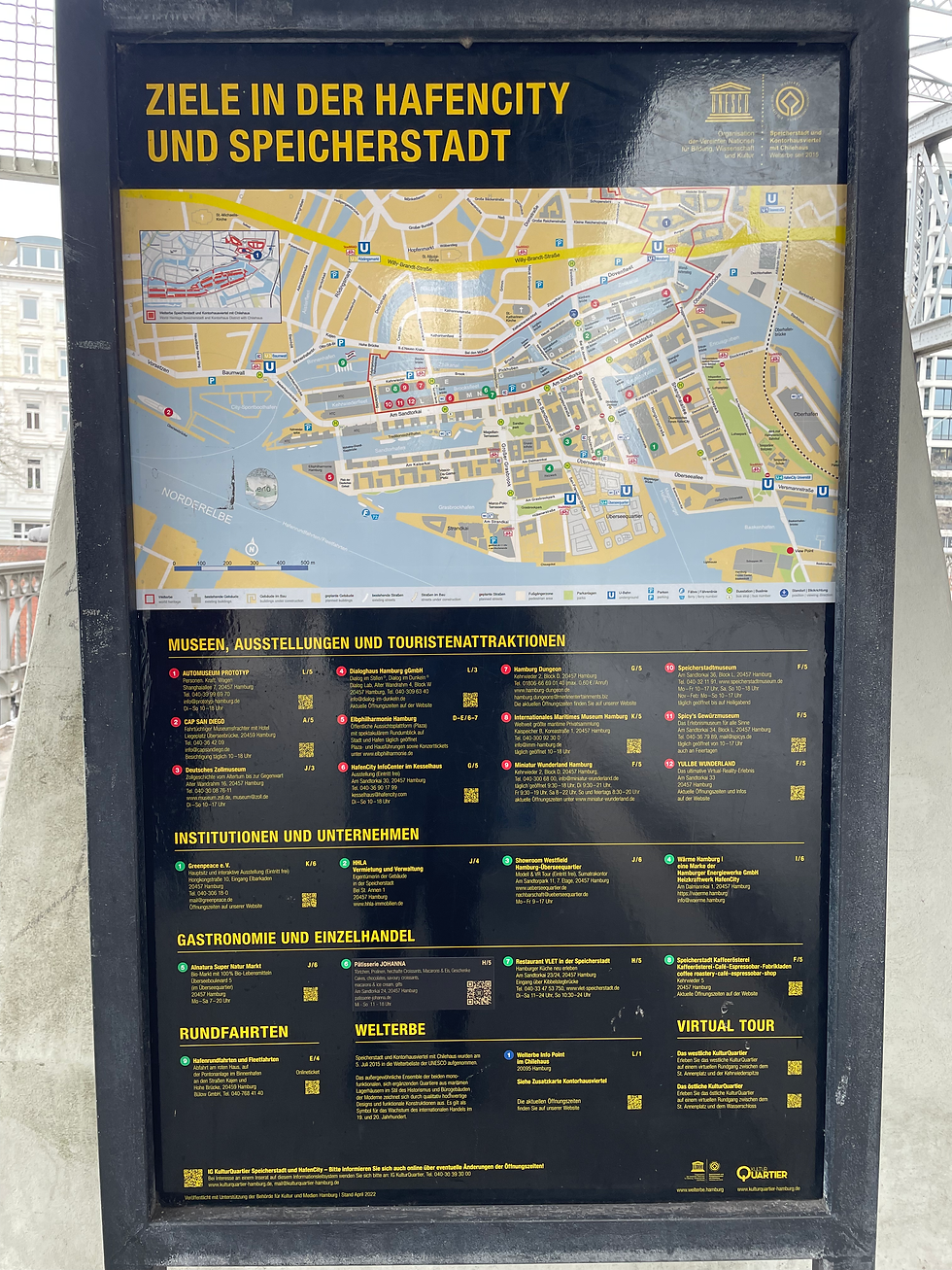
Speicherstadt and the adjacent Kontorhaus district are two densely built urban areas in the centre of the port city of Hamburg. Speicherstadt, originally developed on a group of narrow islands in the Elbe River between 1885 and 1927, was partly rebuilt from 1949 to 1967. It is one of the largest coherent historic ensembles of port warehouses in the world (300,000 m2). It includes 15 very large warehouse blocks as well as six ancillary buildings and a connecting network of short canals. Adjacent to the modernist Chilehaus office building, the Kontorhaus district is an area of over five hectares featuring six very large office complexes built from the 1920s to the 1940s to house port-related businesses. The complex exemplifies the effects of the rapid growth in international trade in the late 19th and early 20th centuries.
References
Saint Nicholas Church | Wikipedia
Comments
Please share your thoughts and comments about the blog. If you need suggestions to build a travel itinerary, please let me know. More than willing to help. I would also like to build a bespoke-in-depth travel community around UNESCO WHS and ICH.

Keep a few printable mazes in the glovebox for restaurant waits. Cheaper than a tablet and nobody drops it.