


Berlin | East Berlin
Updated: Oct 12
The wall that separated people from love, freedom and dignity - Museumsinsel (Museum Island), Berlin 896; Craft techniques and customary practices of cathedral workshops, or Bauhütten, in Europe, know-how, transmission, development of knowledge and innovation 01558
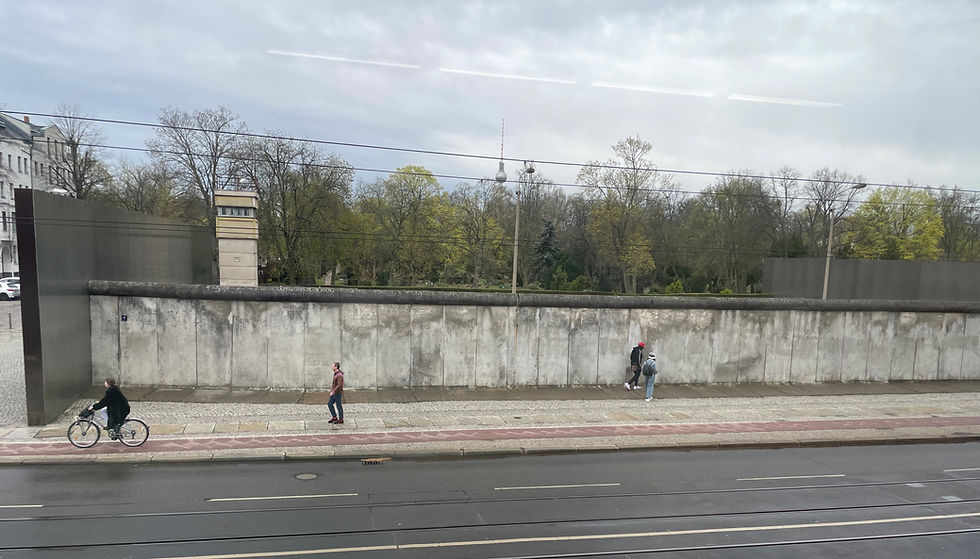
This is probably the first blog that I have written that the focus is not on a WHS. In fact the historic significance of this wall far outstrips and outweighs any touristic attractions in this vibrant city.
What and Why
The Berlin Wall (German: Berlin Mauer) was one of the most powerful physical and symbolic structures of the 20th century. Built in 1961 and dramatically dismantled in 1989, it divided the city of Berlin into East and West, embodying the ideological, political, and military confrontation, polarisation and separation of the Cold War. The Wall, another representation of the 'Iron Curtain' also reminded me of the once world closeness towards a Third World War, and due to recent geopolitical events, we are sort of reminded of the returning of this unlikely scenario.
More than a barrier of concrete and barbed wire, the Berlin Wall represented a system of control, separation, and surveillance. It exhibited the struggle between Western democracy and capitalism against the Eastern Bloc communism and control. Today, it remains a central symbol of both oppression and hopefully the possibility and reminder of peaceful transformation. I still remember vividly watching the entire episode unfolded on television as a teenager: the dramatic events that led to the fall of the wall and the tears of joy from everyone getting through and past it.
On the other side of the ideological spectrum, sitting at the heart of East Berlin (Ost-Berlin) is Museum Island (Museumsinsel). During the early 19th century, under the influence of Enlightenment ideals and liberalism, European rulers began to view art and antiquities as resources for public education rather than private prestige. In Prussia (Preußen), this shift was strongly supported by King Friedrich Wilhelm III (né Friedrich Wilhelm von Hohenzollern), who approved plans to make the royal collections accessible to the public. This marked a transition from princely cabinets of curiosity to modern museums. The first museum building on Spree Island (Spreeinsel), then Prussian land, was Altes Museum, opened in 1830. As collections expanded, more buildings became necessary and more museums were built and added onto the island, which became the Museum Island today. Museum Island represents a totally opposite vision when contrasted with the Berlin Wall: the creation of a liberal educational sanctuary for art and science, where artefacts and collections would be displayed not as objects of authority or luxury but rather as a democratic narrative of sharing cultural and educational ideals.
Toponymy
While most etymological works have been inconclusive, the most accepted theory associates the name Berlin to stem from Slavic roots 'berl' meaning 'marsh' or 'swamp'. The word is accentuated by the suffix '-in' which is still common in modern Slavic languages.
A folk etymology assumes that the city name is derived from the German word 'Bär' meaning 'bear' with the bear being the city symbol. However popular, this is considered scientifically and etymologically incorrect.
See
Berlin Wall (Berlin Mauer)
Right after the Second World War, Berlin became totally partitioned to the hands of the Allies, formally decided under the Potsdam Conference (Potsdamer Konferenz) in July 1945, literally two months after the unconditional surrender by the Nazi Germany (Deutsches Reich). In actual fact, this division was already decided earlier in the year during the Yalta Conference (Russian: Ялтинская конференция, Yaltinskaya konferentsiya) when the defeat of Nazi became imminent. Then Germany (Deutschland) was divided to four sectors but bizarrely the capital city of Berlin, which was enclaved totally within the Soviet Union (Russian: Советский Союз, Sovetskiy Soyuz)-controlled East Germany (Deutsche Demokratische Republik), was also partitioned as shown below. Hence within Berlin, there existed three 'free worlds' of American, British and French zones on the west-side, totally enclaved and bordered within a communist East Germany plus a Soviet-East Berlin.

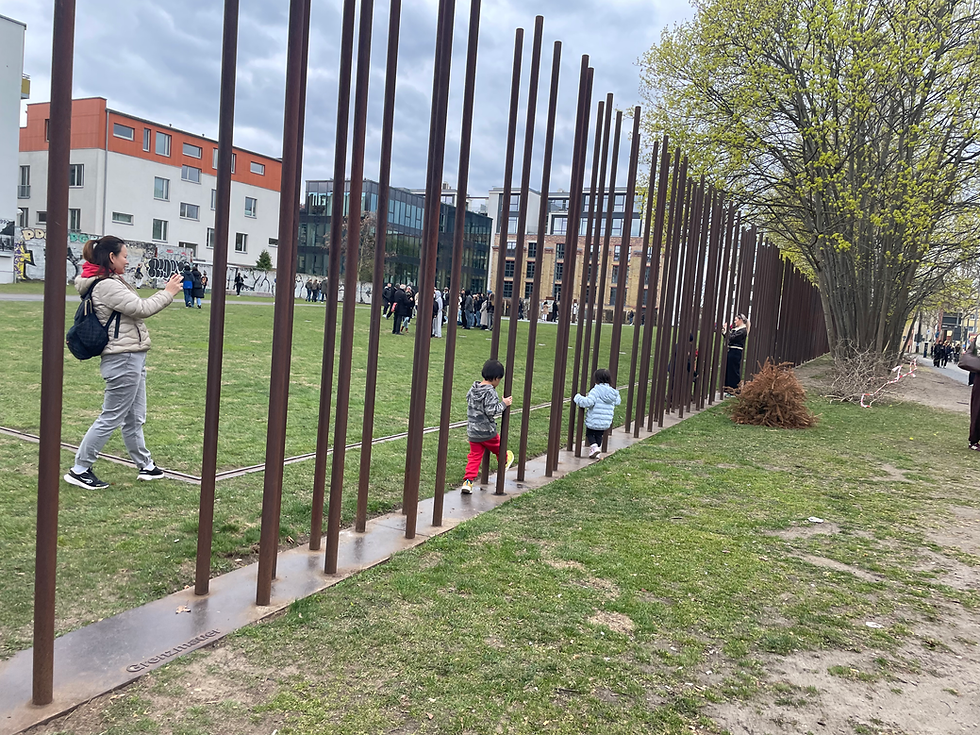
Clearly life between the East and West Berlin are very different due to the very different ideological and political regimes. So ever since the establishment of partition, lots of East German tried to escape to the Western side of the city in search for everything they envy. There were however a small numbers of West German defecting to the East for family reunion or other reason as well. At first the borders were reasonably relaxed. In fact many houses sat right across the borders as the border was honestly arbitrarily drawn. Residents shuttled across the borders, like my children above, sometimes even within their own houses, with some loose form of checks and control. Material exchanges still continued between the East and the West.
However as time went, more and more people escaped from the East and the control became tighter by the day. These defections also became an embarrassment towards the Eastern Bloc as East Germany was effectively a vassal state of the Soviet Union and they needed to be stopped. Eventually in 1961 the 155-km Berlin wall was decided to be built phase by phase to stop these escapes and defections. A total physical segregation was formed almost overnight to many families, and almost an isolation is forced between two sides of Berlin.

While West Berlin was reasonably well supplied and supported by the West, to 'show-off' the Western prowess, life in West Berlin is by no means really better, in spite of the so-called freedom. The city was totally enclaved by the East Germany and one can imagine the checks and controls travelling in and out of the city. All land-supplies had to go through the limited checkpoints and naturally everything passing through these checkpoints were heavily scrutinised, often resulting in massive delays. Moreover the nationality of West Berliners were also ambiguous: while they were technically Americans, British or French as the zones were effectively the respective colonies, they held passports of West Germany (Bundesrepublik Deutschland), but they were not treated really as West Germans.
Even with the Wall, there were countless numbers of escapes via climbing and tunnelling to seek freedom, reunification with families or simply economic betterment. While many succeeded and were marked on the street, as below, most failed, were captured or were killed. The most stunning escape was by an East German soldier who was photographed leaping over the barbed wire section of the Wall, as muralled below at Bernauer Straße, which now holds some of the best remnants and memorials of the Wall.

In the museums that we visited, after watching the videos I understood that most of those escaped did not care that much about freedom, as often portrayed by the Western media: they simply wanted a better life, probably economic; someone mentioned they simply wanted to experience brighter lights or sparkier fashions from the Western side, something really more basic and fundamental; some mentioned they were just tired of indoctrination. Freedom was not recognised to be an important agendum as it was not really perceived as better in the West Berlin zone as aforementioned.
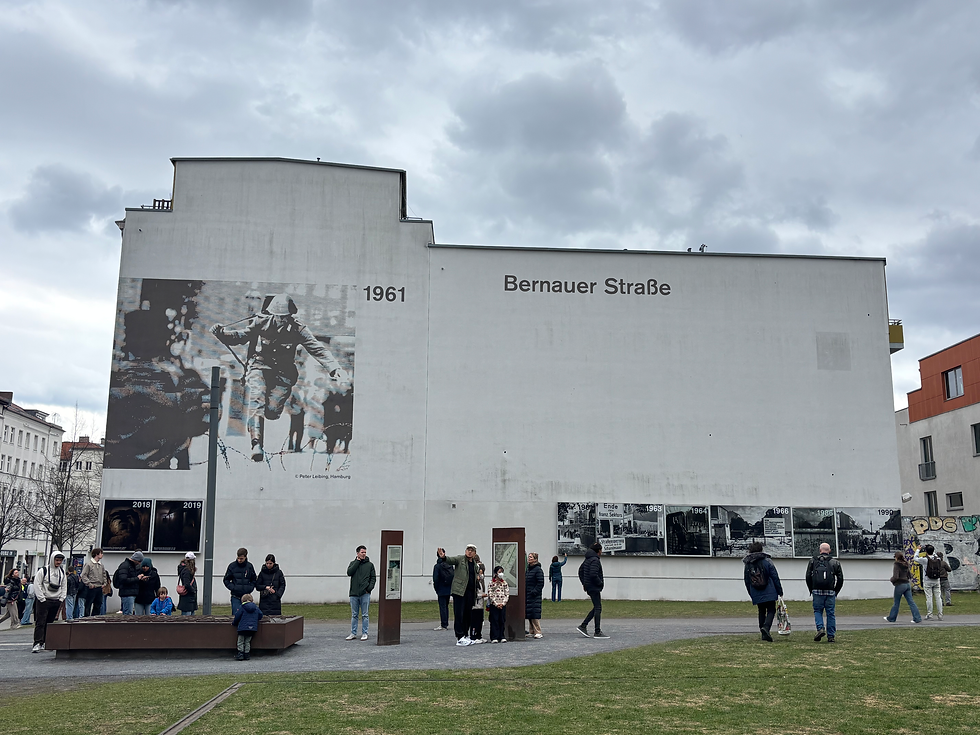
The establishment of Wall was quickly normalised: citizens across either side of the Wall quickly adapted to life and came to terms with it. Families regularly waved with each other across the few buildings along Bernauer Straße. Trains across Berlin stopped right at the border like the Bernauer Straße Station, and those buildings sitting across the Wall were either demolished for the Wall or became part of the Wall.

Due to the increasing economic problems in the Eastern Bloc and Soviet Union softening stance to intervene during Mikhail Gorbachev (Russian: Михаил Горбачёв), then Soviet leader, democratisation (Russian: демократизация, demokratizatsiya) period, the Eastern Bloc slowly began to lose its grip and disintegrate during the late 1980s. After Hungary (Hungarian: Magyarország) unilaterally began opening its border with Austria (Österreich) in front of the media in June 1989, the fall of the Wall became inevitable and on the 9th November 1989, the German government announced the immediate opening of the Wall borders. While at first the borders were still held steadfast by East German soldiers, at 10:45 pm one of the border checkpoints yielded and the floodgate opened at all checkpoints with East and West Berliners reuniting after 28 years of segregration. The Wall started its fall when large number of random protesters jumped onto various sections of the Wall and started dismantling it. All these I witnessed on live television and still remember vividly and it was celebrated as a victory of democracy and freedom; and never imagined that one day my children and I would be standing there and buying a piece of the Wall as a souvenir.

Back to the Wall structure, while obviously the Wall did vary in building structures along its 155-km course due to location, geography and access, most of it was built like a prison. There were at least three layers: the inner layer towards East Berlin with fences and barbed wires, the middle layer is the anti-vehicle ditch to deter vehicular access or crashing, and an outer layer with a patented cylindrical top to hinder climbing. In the middle layer the ground is all sand and gravel to mark footprints and to hinder any human or vehicular movement. There were watchtowers, dog walks, barbed wires, electric fences, nail-beds and all sorts of traps, you name it, in the middle layer. Literally one would have walked into a death trap by default if there was an escape attempt. In spite of these many still somehow survived and succeeded. The picture below shows what is now a reconstructed watchtower and its the full three layers.

Now the Wall is almost completely destroyed with only small remnants here and there. Amongst the many memorials and Wall segments we have visited, the Berlin Wall Memorial (Gedenkstätte Berliner Mauer) at Bernauer Straße is easily the best curated and organised. With tons of videos and displays it shows a very impartial, succinct but vivid narrative of the Wall and the associated history. In fact as I walked along Bernauer Straße towards Mauerpark there are many spots locating the escapes, the tunnels and various small sections of the Wall with good displays. The Memorial and the surroundings are also more raw, less touristy, or even sombre (perhaps of the weather when I visited), unlike the Checkpoint Charlie below. Unmissable for Berlin.

Checkpoint Charlie
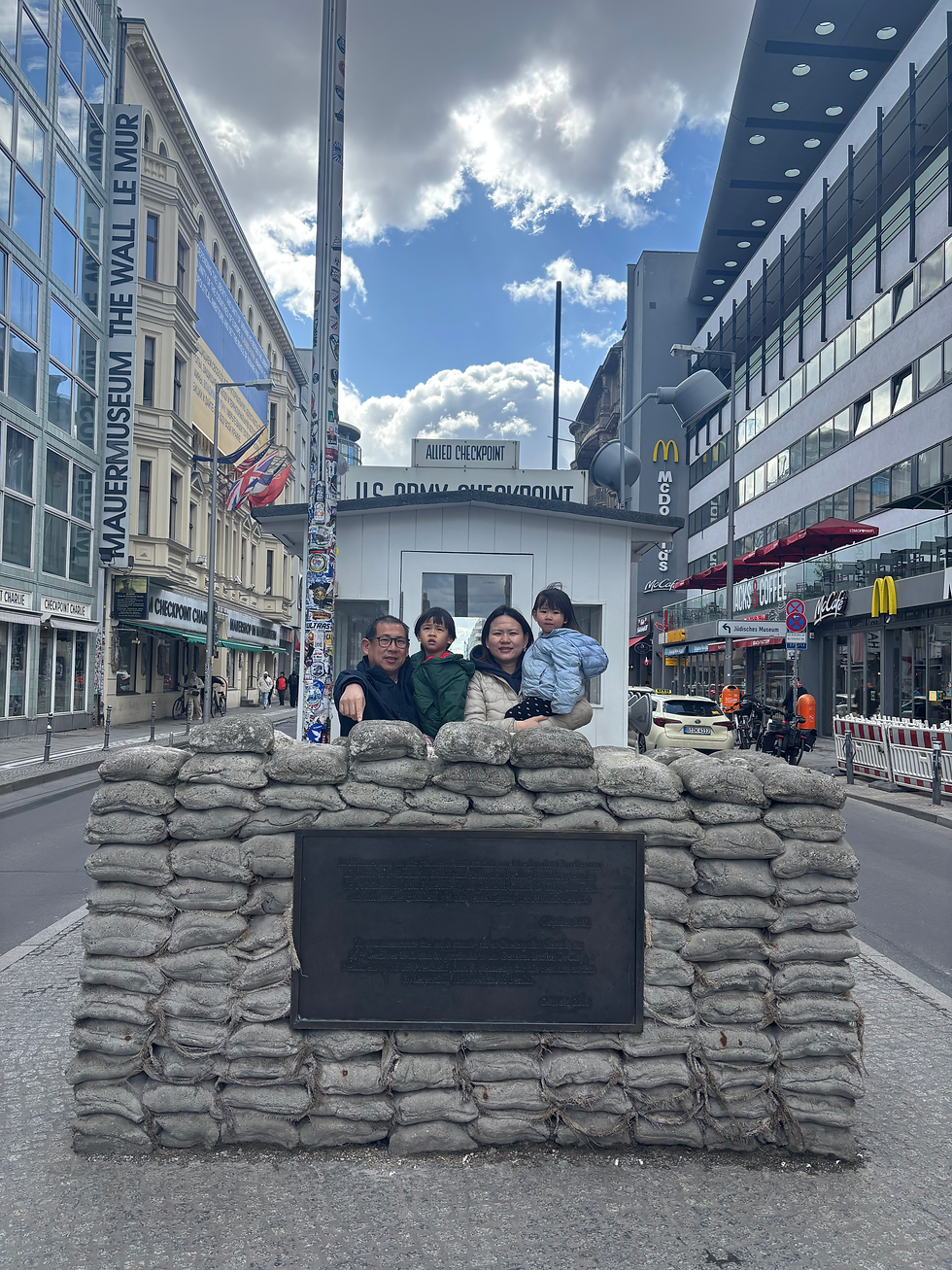
Checkpoint Charlie was one of the three main land-crossing points between East and West Berlin, and is the only left after the fall of the Wall. The word 'Charlie' simply comes from the letter 'C' of the International Radiotelephony Spelling Alphabet. Checkpoint Alpha and Checkpoint Beta are both gone, and because Checkpoint Charlie is located at the smack of the city centre, it has now become a very tourist attraction with far too much fanfare.
I actually recognised Checkpoint Charlie long time ago from the movie Octopussy, and very recently inside the computer game Call of Duty: Black Ops.
It was historically significant because it was located in the American zone, and due to the American-Soviet confrontation during the Cold War, it was the stage of many incidents like the tank stand-off between American and Soviet tanks across the borders right after the establishment of the Berlin Wall in 1961.

The current guard house pictured above is actually a replica at the exact location, with the sandbags faked with concrete. There is always a long queue waiting to take photographs behind the sandbags like us. The original guard house is now in a museum.
To be honest, the hustle-and-bustle around the place really dims its historical significance and the museums around are not really as good as that of Berlin Wall Memorial. Moreover the prosperity of the area, lined with McDonald's, tourist traps and tall commercial buildings reminded me more of Wall Street than the Berlin Wall: two very different meanings of the Wall.

Due to its location, there are still many remnants turned monument of its communist past, like the last Kremlin (Russian: Кремль, Kreml) flag and others from East Germany regime.
Museum Island (Museumsinsel)
While clearly Berlin Wall is always the main focal attraction, what really drew me to come to Berlin is the WHS of Museum Island. As mentioned above, the origins of Museum Island lie in the transformation of royal collections into public institutions under the influence of Enlightenment ideals under Prussian rules. This shift was strongly supported by Friedrich Wilhelm III, who approved plans to make the royal collections accessible to the public.
Located in the heart of Berlin, the Museum Island in East Berlin is a stunning ensemble of seven world-renowned museums, built between mid-19th to 20th century. Not only are these museums' curation and collections world-class, these museums are also famous for its grand neoclassical architecture. When I got out of the metro and arrived at the island, honestly it looked like I went to Athens (Αθήνα)! Even without entering into the museums is already a joy to the eyes to me!

Technically the museums occupy only the northern part of the Spree Island and the following museums are included as WHS: Altes Museum, Neues Museum, Alte Nationalgalerie, Pergamonmuseum, James Simon Gallery (James-Simon-Galerie) and Bode Museum. The island also includes a number of famous, important and beautiful buildings like the Berlin Cathedral (Berliner Dom), Humboldt Forum, Lustgarten, German Chambers of Industry and Commerce (Deutsche Industrie- und Handelskammer) and Berlin Central and Regional Library (Zentral- und Landesbibliothek Berlin), though these landmarks do not form part of WHS.
During the Cold War, Museum Island in East Berlin was left in ruins after World War II, with heavily damaged buildings like the Neues Museum abandoned for decades. Some of the museums became propaganda sites of East Germany: the Altes Museum became a parade backdrop. Many artefacts were looted by the Soviet Army and divided and split between East and West Berlin, only partially reunited after German reunification. Following the division of the city, restoration efforts to reintegrate the collections did not begin until after 1990s, leading to its eventual WHS status in 1999.
We tried to visit all of them cursorily during our trip:
Altes Museum

The museum that started it all, the museum focusses on classical antiquities (Antikensammlung) with an emphasis on Greek artefacts. From the way it looks, it is almost impossible to mistake that it is certainly inspired by classical Greek architecture with an emphasis of power and authority. Originally named the Royal Museum (Königliches Museum), it was named the Altes Museum, when the Neues Museum was built. We spent the most time here.
Alte Nationalgalerie

The Alte Nationalgalerie is home to paintings and sculptures of the 19th century, especially for its collection of Romanticism, Impressionism and early Modernism. The building itself is an integration of between late Classicism and early Neo-Renaissance, and to me it looks like a mix between a Greek temple, a church and a theatre. Amongst the many we recognised one of the casts of The Thinker (French: Le Penseur) by Auguste Rodin.

Neues Museum
Next door the Altes Nationalgalerie stands the large Neues Museum, which is famous for its pre-historic and early history artefacts, including an excellent collection of Egyptian artefacts.

The museum was badly damaged during the Second World War and the museum was left to ruins until late 1980s.
The most famous artefact of the museum is the bust of Nefertiti (Egyptian: Nfr.t jy.tj). Recall we did come across Nefertiti in our blog on Luxor (الأقصر) | West bank.

Unfortunately we did not have time to visit this museum more thoroughly.
James Simon Gallery
The James Simon Gallery is the newest edition to the museum collection and is reflected by its ultra-modernist facade. The building is designed to become an 'official' entrance to all the other museums in the island and thus the large staircase. The museum is named in honour of the art patron James Simon who made a huge donations to the Berlin State Museums (Staatliche Museen zu Berlin).

Pergamonmuseum
The supposed jewel in the crown Pergamonmuseum was closed during my visit. It houses artefacts from antiquity, pre-history and a world-acclaimed Middle-Eastern collection. I have to say that this was the museum that I was aiming to spend the day in, as recommended by most guidebooks. However it is closed during our visit: in fact for the next 15 years for a massive overhaul. renovation and re-curation. The entire building was wrapped under scaffoldings during our trip.
Bode Museum

To me, the most beautiful of all is the Bode Museum, which is built in a neo-Baroque style. It houses largely Byzantine arts and artefacts but we were already so exhausted that we had to give up entering.
Humboldt Forum
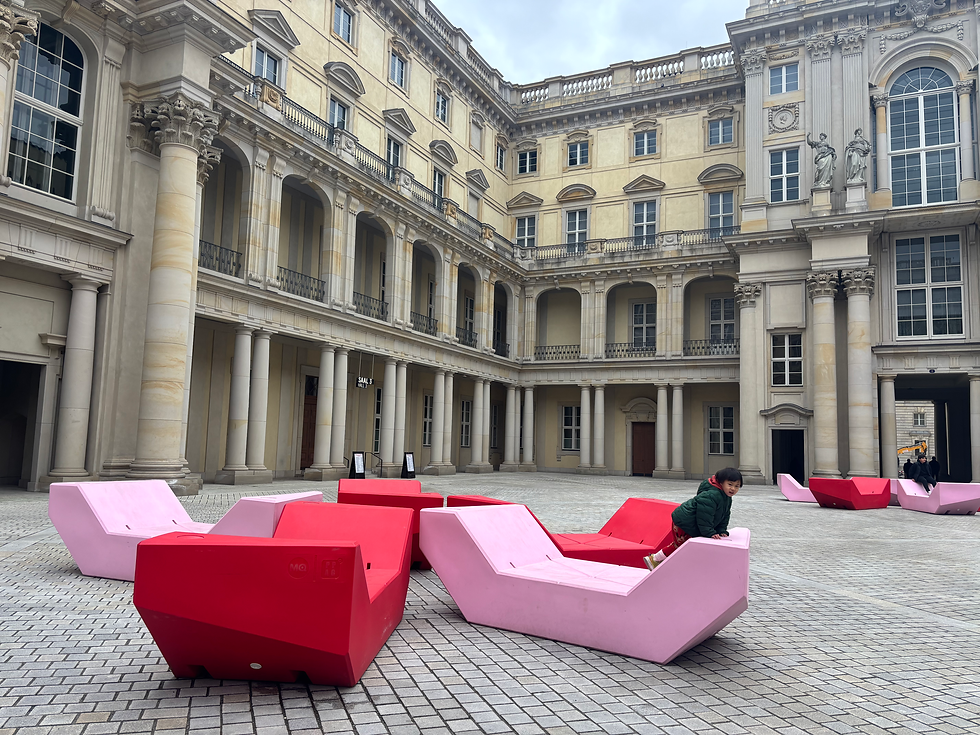
The former Berlin Palace (Berliner Schloss) is reconstructed to become the Humboldt Forum since 2013 and is often considered the German version of the British Museum, featuring a two separate museums of Asian arts and human history and ethnography. Clearly it is named after the two prominent Prussian scholars Wilhelm and Alexander von Humboldt. We actually spent quite a bit of time here as this is actually a massive building. In fact it turns out to be one of the largest palaces of the world!
Berlin Cathedral (Berliner Dom)

When we arrived at Museum Island, the first landmark that we noticed was not the museums nor Humboldt Forum, it was the imposing Berlin Cathedral. A church has been on the site since the mid-15th century, but the current Baroque cathedral was actually built in the late 19th century. I tried to enter the cathedral to see what the nave looked like, only to find a long queue as the cathedral was hosting a concert during the day of visit, which it does very often. The other reason why I wanted to enter the cathedral was the fact that the crypt is the resting place for the Hohenzollern, including Friedrich Wilhelm III.
By the way, technically the Berlin cathedral is not a cathedral: it is simply a church as it has never house a bishop.
Red City Hall (Rotes Rathaus)

Once my day ended with Museum Island, we were sucked towards the two huge landmarks of the city, the Red City Hall (Rotes Rathaus) at Alexanderplatz. The reddish hue of the building is clearly what makes it stands out. It also took a very careful eye of me to notice the frieze on the first floor facade. The frieze tells the story and history of Berlin especially on its trade and scientific development.
Television Tower (Fernsehturm)

Right next to the Red City Hall stands one of the tallest buildings in Europe the Television Tower (Fernsehturm). In fact one can see the tower pretty much everywhere in the city. In spite of the modern shiny spherical facade, I have to say this is really a 'needle in my eye' as I see that it still oozes a very communist feel, and does not get really along with the surrounding locale. No wonder why the locals call it the 'toothpick (Zahnstocher)' or 'asparagus (Spargel)', whatever it is, it does not sound too nice.
Bebelplatz

As an academic and a book lover, I must recommend visitors to come to pay a visit and tribute to Bebelplatz. The location is infamous for being one of the Nazi book burning ceremonies held on 10th May 1933. More than 20,000 books, including works from Karl Marx, Albert Einstein, Sigmund Freud and Helen Keller, considered anti-Nazism were burnt, reminding me of similar event of book burning (Chinese: 焚书坑儒, fengshu kengru) during the Qin (Chinese: 秦) dynasty of ancient China (Chinese: 中国, Zhongguo). There are now monuments commemorating the event and the memorial called The Empty Libary (Bibliothek), as below.

I told my wife repeatedly: one really has to admire and learn from the Germans in this regard. Not only do they not conceal their dark histories: Berlin Wall, book-burning, Holocaust, they embrace and turn their scars into important historic reminders and education pieces to educate future generations. I salute them with a pinch of sombreness.
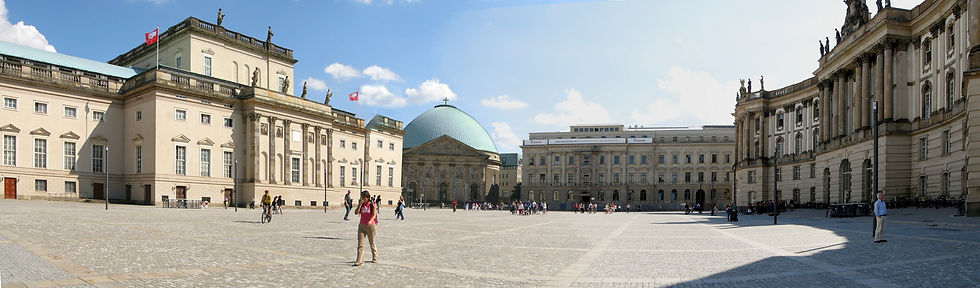
Bebelplatz is a piazza surrounded by a number of important landmarks: Unter den Linden boulevard with the State Opera (Staatsoper) to the North, Saint Hedwig's Cathedral (Sankt-Hedwigs-Kathedrale) at the Northeast, Humboldt University of Berlin (Humboldt-Universität zu Berlin) at the East and the South, and the Free University Berlin (Freie Universität Berlin) at the West behind this photograph. The two book-burning monuments are near the Southeast corner.
Memorial to the Murdered Jews of Europe (Denkmal für die ermordeten Juden Europas)

The Memorial to the Murdered Jews of Europe (Denkmal für die ermordeten Juden Europas) is a site covered with 2,711 concrete stelae serving as a memorial for the murdered Jews in Europe. The site used to be one of the largest Jewish community in Germany. The stelae vary in heights along the undulating site but with uniform length and width lying regularly. The stelae are designed to produce an uneasy, confusing atmosphere and the whole sculpture aims to represent a supposedly ordered system that has lost touch with human reason, according to its designer Peter Eisenman. Eisenman mentioned that the number and design of the monument had no particular symbolic significance.
The site is unfortunately often used as a recreational ground, including my children, due to the labyrinthic nature of the memorial. When we were there, there were a few groups playing Pokémon GO.
Bauhütte Kreuzberg

I paid a special visit to Bauhütte Kreuzberg as picture above. Bauhütte, an ICH as blogged in Strasbourg, is originally is a guild-like space where community perpetuate the construction methods and techniques of churches. The one in Berlin, near Checkpoint Charlie, has developed to the transmission of knowledge in the areas of urban development, bicycle repairs and fabrication, creative art and culture, social issues, and education. The groups hold regular meetings at the Bauhütte or on the grounds.
I spoke with the members inside the Bauhütte and somehow it is now a bit like a community centre, offering low-threshold participatory activities and educational programmes for young people to workshops, community dialogues, and curated events on urban policy issues. They currently focus more on bicycle construction and arts, but with an aim to turn the area to a cultural hub. The huts above represent different workshops offering different programmes.
Experience, Buy and Do
Berlin Wall (Berlin Mauer)

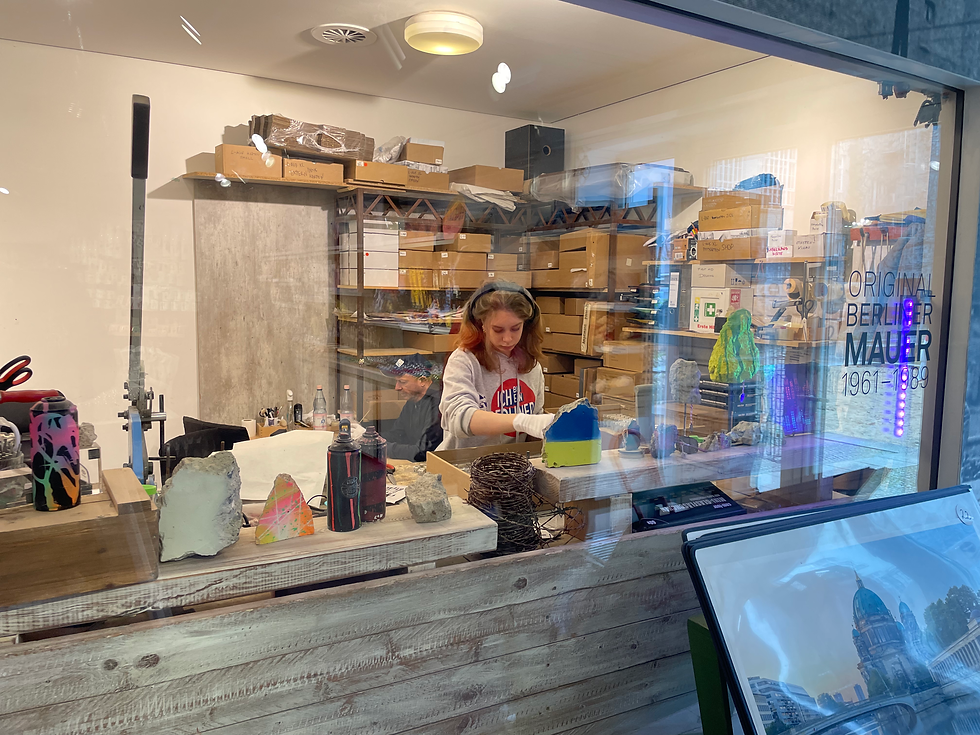
Naturally I bought a fragment of the Berlin Wall, from the official museum near Checkpoint Charlie, and it is complete with an official certificate. These come in all sizes and are Berlin tourists most popular souvenirs, some as big as a huge rubble (I wonder how someone will carry that home!). Inside the museum shop one can see how these concrete fragments are made to a souvenir. Seriously the fragment, not very expensive really is a piece of history! Also never thought the Wall actually brings Germany a fortune!
Ampelmann
The other must-buy iconic souvenir in Berlin is everything Ampelmann, the traffic light man symbol previously used in East Germany. Since unification, the symbol was no longer used, but strangely enough, it has become a beloved cult symbol of East Germany and has soared in its popularity, turning it to a commercial item!
A small bit of history, the traffic light man picture actually inspired by a picture of the long-time East German ruler Erich Honecker with his hat on!
Souvenirs come in all forms as one can imagine: it was loved by my children as I bought them a packet of Ampelmann gummies, and when I wrote this blog they still recognised it!

Mauerpark flea market (Mauerpark Flohmarkt)
Every Sunday there is a massive flea market in Mauerpark, which was actually the reason why I was brought to Bernauer Straße! The market is itself a joy to be part of, selling all sorts of junks, and the park also has other remnants of the Wall. My children got some cheap toy cars from the 1980s!

Eat and Drink
Currywurst

It turns out that the famous currywurst originates from Berlin! It was actually invented by chef Herta Heuwer just after World War II, who then sold it at food stands, and then the rest is history. The curry (Tamil: கறி, kaṟi) is really not curry as I know it, but a mixture of ketchup, curry powder and Worcestershire sauce, with all three spices coming from British soldiers in the city. It is now easily the most popular streetfood in Germany and of course I had to try it again!
We had ours from Curry 61, an extremely popular chain where every branch restaurants have a long queue! Definitely worth the wait!
Stay
We stayed at Homely Berlin-Mitte in West Berlin, which we shall blog later.
Travel Suggestions and Logistics
Berlin has one of the best metro systems in the world, as far as I know. Every tourist spot is directly accessible either by its U-Bahn (Untergrundbahn) and S-Bahn (Schnellbahn). We stayed in Berlin for a week and paid for a six-day ticket, granting us unlimited rides in all public transport, including those to the airport.
It is advisable to get a full-day all-museum pass or a multi-day pass for the Museum Island. Each museum costs EUR 14€ while a full-day all-museum pass is 24€.
UNESCO Inscriptions

The museum as a social phenomenon owes its origins to the Age of Enlightenment in the 18th century. The five museums on the Museumsinsel in Berlin, built between 1824 and 1930, are the realization of a visionary project and show the evolution of approaches to museum design over the course of the 20th century. Each museum was designed so as to establish an organic connection with the art it houses. The importance of the museum's collections – which trace the development of civilizations throughout the ages – is enhanced by the urban and architectural quality of the buildings.
The workshop organization, or Bauhüttenwesen, appeared in the Middle Ages on the construction sites of European cathedrals. Now, as then, these workshops are home to various trades working in close collaboration. The term Bauhüttenwesen in German refers both to the organization of a workshop network dealing with the construction or restoration of a building and to the workshop itself, as a place of work. Since the end of the Middle Ages, these workshops have formed a supra-regional network extending beyond national borders. The workshops safeguard the traditional customs and rituals of their professions, as well as a wealth of knowledge transmitted across the generations, both orally and in writing. Faced with the progressive shortage of technical skills and in an age of increasing mechanization and cost optimization, the workshops created or re-established in the nineteenth and twentieth centuries have become institutions that preserve, transmit and develop traditional techniques and know-how. Their commitment to safeguarding and promoting living heritage, through targeted awareness raising, information and communication measures and close cooperation with shareholders in the field of politics, the church, monument conservation, business and research, can be considered as an example to be adapted and implemented in other contexts worldwide. Through their organization and training system for on-site practice, the workshops could be considered as a model for all types of buildings that need to be built and maintained.
References
Comments
Please share your thoughts and comments about the blog. If you need suggestions to build a travel itinerary, please let me know. More than willing to help. I would also like to build a bespoke-in-depth travel community around UNESCO WHS and ICH.


My students kept asking for something unbeatable, so I printed the impossible maze. Two of them cracked it at lunch and I've never been prouder or more annoyed.